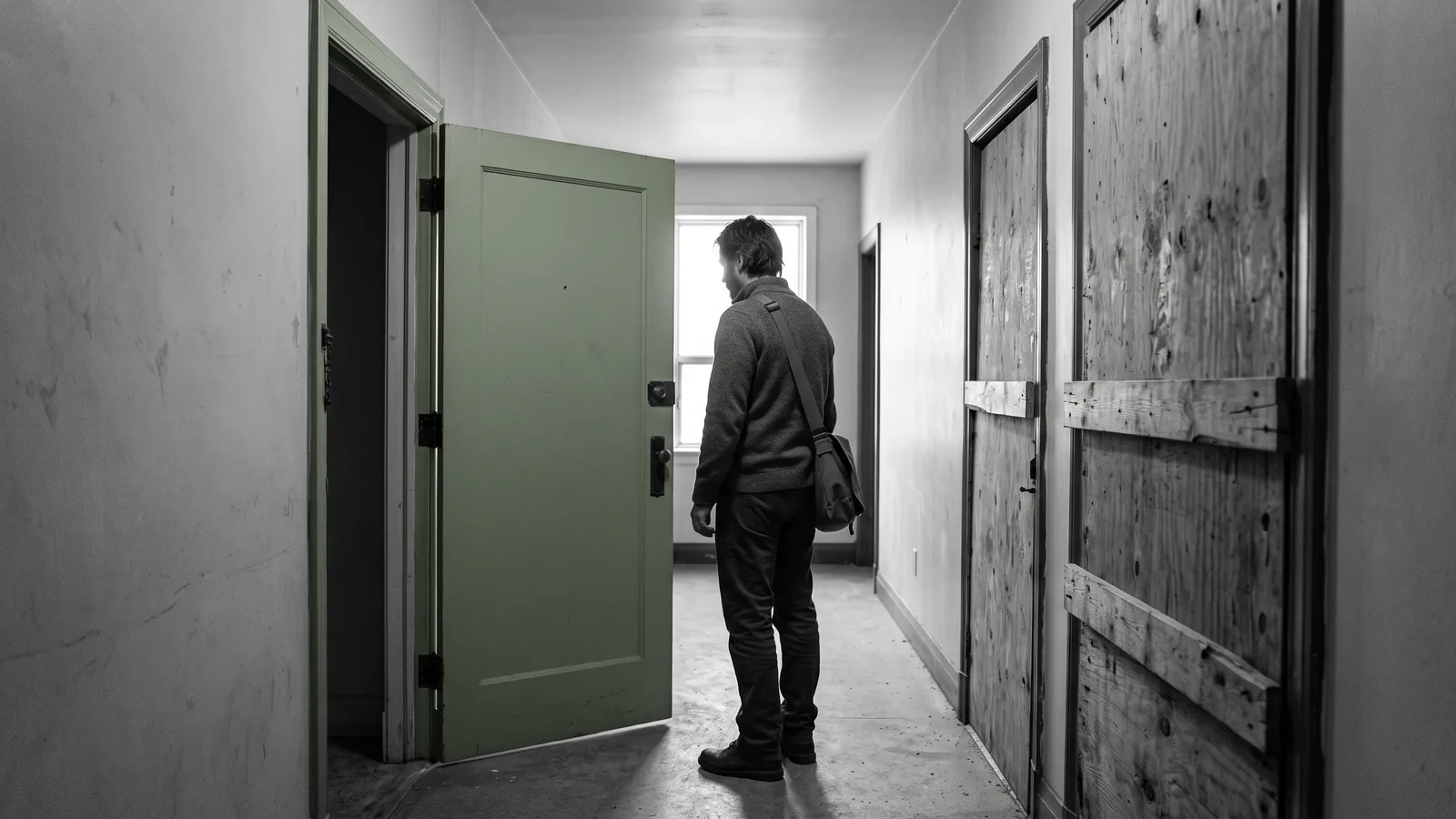
There are two ways to recover a dwelling whose rent has stayed frozen far below market. The first is to reach an agreement with the tenant: you offer them compensation, they freely agree to leave, everyone signs. The second is to push them out — by invoking work, an accommodating repossession, or simply by making their life unpleasant enough that they eventually give in. This second method is called “renoviction.” It looks like a shortcut; in reality, it is the longest and most costly path. This article clearly explains the difference between these two routes, why the wrong one regularly ends up before Québec's rental board (the TAL) and in the media, and how to reach exactly the same objective — a dwelling recovered and brought back to its fair value — without gambling your money or your reputation.
In this article
- Renoviction: a word that makes the headlines
- Cash for keys vs renoviction: two opposing logics
- Why these shortcuts happen
- Why it ends badly: the consequences
- The grey area: diverted repossession, pretextual work, harassment
- The legal way to do it: the voluntary agreement
- Why “doing it right” takes pros
- The Opti Loyer approach: pay only for results, zero risk
Renoviction: a word that makes the headlines
The term “renoviction” is a portmanteau: renovation + eviction. It describes a very specific practice: using work — real, exaggerated or outright invented — as a pretext to evict a tenant in good standing, in order to re-rent the dwelling at a higher price to someone else. The word does not exist as such in the legislation, but the reality it covers is heavily regulated. And for some years now, it has taken up a growing place in Québec news: reports, columns, tenant-association files, TAL decisions commented on publicly. This type of case regularly makes the headlines, and that is no accident: the housing crisis has made every affordable dwelling precious, and every dubious eviction visible.
Why this subject has become so sensitive
In Québec, the tenant enjoys a strong right: the right to remain in the dwelling. As long as they meet their obligations, they can stay in their home, and the landlord cannot simply decide not to renew the lease in order to take back the dwelling. This right is one of the pillars of Québec residential-lease law. Renoviction is seen — rightly — as an attempt to bypass this right through cunning rather than through respect for the rules. In a context where affordable dwellings are becoming scarce, an eviction that smells of a pretext immediately attracts the attention of the public, the media and the courts.
What the law actually regulates
We have to be precise, because confusion is common. There are legal mechanisms to end a lease or take back a dwelling: repossession of a dwelling (to house oneself or an eligible relative), eviction for subdivision, substantial enlargement or change of use, and of course the voluntary move-out agreement. Each of these mechanisms is subject to its own conditions, governed by the Civil Code of Québec, the housing legislation and the TAL's rules. Abusive renoviction is none of these mechanisms properly applied: it is their diversion, or the use of fictitious work and pressure to reach a result the law does not allow. It is this nuance — the legal route versus its fraudulent imitation — that separates a solid process from a case that collapses.
Key takeaway
“Renoviction” is not a legal term, but the practice it describes — evicting a tenant under the pretext of work or through coercion in order to re-rent at a higher price — can most certainly be sanctioned. The law regulates legitimate ways to take back a dwelling; renoviction is the diversion of those.
Cash for keys vs renoviction: two opposing logics
Cash for keys and renoviction often aim at the same material objective — freeing a dwelling locked below market — but rest on two radically opposing logics. One starts from agreement, the other from coercion. This opposition is not cosmetic: it determines whether your process is unchallengeable or fragile, profitable or ruinous.
| Cash for keys (voluntary agreement) | Renoviction (shortcut) | |
|---|---|---|
| Starting point | The tenant's free agreement | The will to make the tenant leave |
| Consent | Real, informed, recorded in writing | Absent or extracted under pressure |
| Pretext / reason | None: it is an openly assumed agreement | Inflated work, invented reason, harassment |
| Relationship to the TAL | Nothing to adjudicate, no dispute | Likely challenge, burden of proof |
| Financial risk | A compensation known in advance | Damages, punitive damages, fines |
| Worst-case scenario | The tenant declines the offer | Tenant reinstated + compensation + damaged reputation |
| Reputation | Intact: a respectful process | Exposed to the media and social networks |
Look at the last row of the table. In the best case, renoviction earns a few months of rent. In the worst, it loses the money for the damages, the fees, the time, and the dwelling itself if the tenant is reinstated — not to mention the public record. Cash for keys, on the other hand, has a benign worst case: the tenant says no, and that is the end of it. When the worst case of one route is “we lost nothing” and the other is “we lost everything, in public,” the risk calculation is quickly made.
The difference comes down to one sentence
You can sum up the whole distinction like this: cash for keys asks, renoviction imposes. To ask is to acknowledge that the tenant has a right and to negotiate their departure; to impose is to deny that right and hope that no one challenges it. Yet in the current climate, people do challenge — and increasingly often successfully.
Why these shortcuts happen
To avoid a trap, you have to understand why so many serious landlords, otherwise honest, let themselves be tempted by renoviction. The answer is nothing mysterious: it is a question of money, and the calculation seems irresistible on paper.
The shortfall of a frozen rent
Imagine a dwelling whose rent has stayed, year after year, well below the market price. The gap can represent several hundred dollars a month, meaning thousands of dollars a year in income not collected, and often tens of thousands of dollars in value on the asset itself, since a property is valued according to its income. Faced with such a gap, the landlord feels real economic pressure: they have the impression of “losing” money every month. This objective — bringing the dwelling back to its fair value — is perfectly legitimate. No one can blame a landlord for wanting to optimize their asset.
The shortcut that seems logical
The problem arises in the choice of means. Since a tenant in good standing has the right to stay, and the rent can only be adjusted within the prescribed limits, the landlord in a hurry looks for a quick way out. Renoviction then presents itself as a solution: “I start work, the tenant has to leave, I re-rent at fair value.” In the moment, it looks like a rational business plan. What this reasoning forgets is that the eviction-for-work mechanism exists for specific and genuine situations, not as a commercial lever — and that diverting it makes it challengeable.
Ignorance of the true consequences
Most landlords who slide toward renoviction simply underestimate the risk. They see the months of rent gained, not the potential damages. They imagine that the tenant, once gone, will not come back; they are unaware that the tenant can challenge even after leaving, claim damages, and sometimes ask to be reinstated. They think “discretion”; they forget that these cases often become public. In short, it is not malice in the majority of cases: it is a bad calculation, based on an incomplete view of the consequences. That is precisely why it is worth spelling them out.

Why it ends badly: the consequences
Here is the heart of the matter. Renoviction does not end badly by bad luck; it ends badly structurally, because it attacks a protected right and leaves a trail. Let us review what, concretely, awaits a landlord whose eviction is found to be abusive.
1. The challenge before the TAL
A tenant evicted under a false pretext is not without recourse: they can turn to Québec's rental board (the TAL). And they can do so even after leaving the dwelling. The mere fact that they have left does not close the matter. Before the TAL, it is generally up to the landlord to demonstrate that their process was genuine and in good faith: that the work really justified the eviction, that the repossession was sincere, that the reason invoked was not a screen. If the tribunal detects a pretext, the process collapses.
2. Damages and punitive damages
When an eviction is found to be abusive, the landlord can be ordered to pay damages to compensate the harm suffered by the tenant: moving costs, the rent difference in the new dwelling, trouble and inconvenience. And when bad faith is established, punitive damages may be added: they serve not to compensate, but to punish and deter. We do not put forward specific amounts here — they depend on the facts and the tribunal's assessment — but the important thing is to understand that these sums can wipe out, and far beyond, the hoped-for gain of the operation.
3. The fines provided by law
Beyond the damages awarded to the tenant, certain practices — harassment, attempting to evict a tenant from their dwelling through manoeuvres, false statements in a notice — can expose you to fines provided by law. The ranges vary and evolve; we do not cite a specific figure. Bear the principle in mind: the shortcut is not only risky on the civil side (damages), it can also lead to penalties.
4. The tenant's reinstatement
This is undoubtedly the most counter-intuitive consequence, and the most painful for a landlord. In some cases, when a repossession or an eviction turns out to be a pretext, the TAL can order the reinstatement of the tenant in their dwelling. In other words: after spending time, money, perhaps paying for a move, and believing they had “recovered” their dwelling, the landlord ends up with the same tenant, at the same rent, plus a damages bill. The shortcut then cost infinitely more than the long route — and did not even reach its goal.
5. Reputation and the media
Finally, there is the consequence that no judgment quantifies: reputational harm. Cases of abusive renoviction are regularly the subject of news reports, columns, social-media posts and files taken up by tenant associations. An unfavourable decision can become public. For an individual landlord, an investor or a real-estate company, being associated with this kind of practice leaves a lasting mark: wary tenants, cooled-off partners, an unflattering online search. A reputation takes years to build and a single case to tarnish.
You only have one name in life
It has to be said plainly: you only have one name in life. A landlord's reputation — their name, their company's name, their online presence — is a precious asset, patiently built. Gambling it on a shortcut to save a few months of rent is putting something very valuable on the line against something very modest. No shrewd investor makes that trade when there is a route that reaches the same result without risking anything. That route is the voluntary agreement.
The grey area: diverted repossession, pretextual work, harassment
Renoviction rarely takes a crude form. Most often it borrows legal mechanisms and bends them just enough to serve another purpose. Recognizing these grey areas helps you understand exactly where the line not to cross lies.
The accommodating repossession
Repossession of a dwelling is a real right: you can take back a dwelling to house yourself or an eligible relative. But invoking a repossession for a relative you never intended to move in, for the sole purpose of emptying the dwelling and then re-renting it at a higher price, is a bad-faith repossession. The front beneficiary who never moves in, or who leaves right away to make room for a new tenant at market price, betrays the sincerity of the process. We detail the whole legitimate mechanism, and its pitfalls, in our guide on repossession of a dwelling in Québec.
Work as a pretext
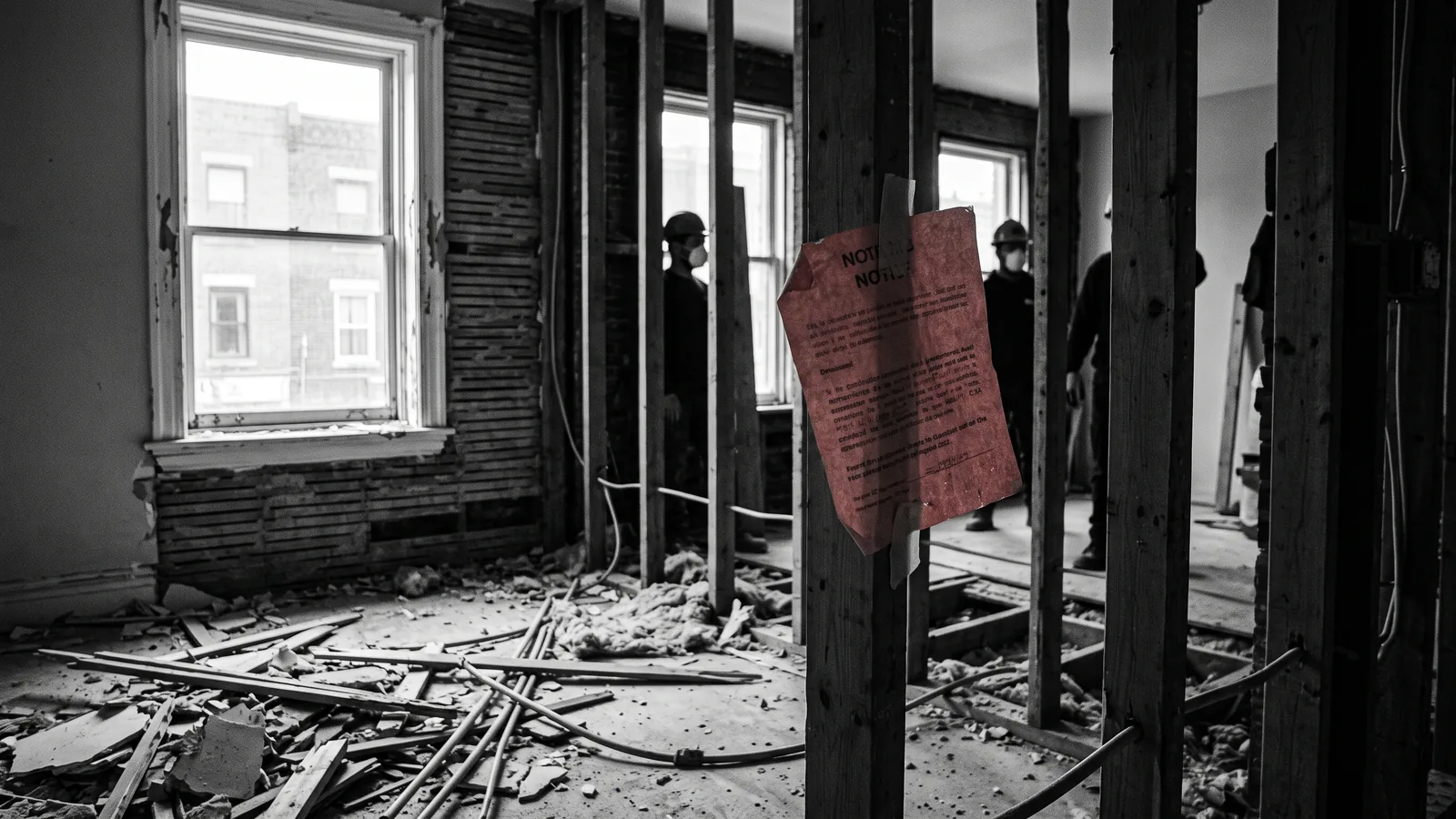
Eviction for major work exists for genuine situations: subdivision, substantial enlargement, change of use. The problem begins when the work is inflated, brought forward or invented to justify a departure that, at bottom, has nothing to do with it. Work that could be done without evicting the tenant, “major” renovations that turn out to be cosmetic once the dwelling is empty, a job site that never happens: all signals the tribunal knows how to read. The pretext eventually shows.
Harassment and pressure
The most insidious form goes through no official notice. It consists of making the tenant's life unpleasant enough that they leave “on their own”: repairs that drag on, intimidating communications, untimely visits, repeated pressure to sign a departure. This is harassment, and the law treats it severely. Not only is it nothing like a voluntary agreement — consent extracted under pressure is not free consent — but it is exactly the kind of conduct that fuels punitive damages and headlines.
The typical pattern that goes off the rails
One scenario comes up often in this type of case: a dwelling rented well below market, a landlord in a hurry, a repossession or work notice sent a little too quickly, a tenant who leaves, then the dwelling re-rented shortly after at a markedly higher price — without the announced repossession or the promised work ever materializing. The tenant looks into it, notices the gap, and brings the matter to the TAL. From there, the burden of proving good faith falls back on the landlord, who often has nothing solid to present. It is the classic pattern of the shortcut that backfires: nothing exotic, just a legitimate objective pursued through the wrong means.
What do these grey areas have in common? They all rest on a mismatch between what you declare and what you actually do. And that mismatch, sooner or later, shows. The legal route, by contrast, has nothing to hide: it owns the objective and reaches it through agreement.
The legal way to do it: the voluntary agreement
Good news: the objective pursued by renoviction — recovering a dwelling to bring it back to its fair value — is perfectly achievable legally. The tool is called the voluntary agreement, and it takes two main forms: cash for keys and cash for raise.
Cash for keys: buy the departure, don't force it
Cash for keys is a mutually agreed lease termination. Instead of looking for a reason to evict the tenant, you offer them compensation in exchange for their departure on an agreed date. If they accept, both parties sign a clear agreement, and that's it: no reason to justify, no burden of proof, no possible challenge, since everyone is in agreement. The tenant is never forced; they accept because the offer suits them. It is legal, voluntary and, done properly, unchallengeable. We explain the full mechanics in our guides “Cash for keys in Québec” and “How to do a cash for keys”.
Cash for raise: keep the tenant, adjust the rent
Sometimes it is not even necessary for the tenant to leave. Cash for raise is an agreement whereby the tenant accepts a rent increase, often in exchange for an incentive or agreed improvements. You bring the rent closer to market without vacancy, without a move, without rupture: the tenant stays, but on the new terms they have accepted. It is an elegant solution when the relationship is good and the tenant prefers to stay put.
Why the voluntary agreement is unchallengeable
The strength of these two approaches comes down to one word: consent. You cannot challenge before a tribunal an agreement you freely signed and from which you obtained a consideration. There is no imposed reason to demolish, no good faith to prove, no pretext to unmask: there is only an agreement between two adult parties. It is exactly the opposite of renoviction, whose entire fragility comes from the absence of real consent. Where renoviction hopes that no one challenges it, the voluntary agreement cannot be challenged on the merits, because there is nothing to adjudicate.
Key takeaway
The rule is simple: you don't force, you reach an agreement. Cash for keys recovers the dwelling amicably; cash for raise adjusts the rent without a departure. In both cases, the tenant's free consent makes the process solid and unchallengeable — the exact opposite of renoviction.
Why “doing it right” takes pros
Here is a truth that is stated too rarely: a voluntary agreement is legal, but it is not easy. The difference between an agreement that holds and a process that goes off the rails plays out in the details — and each of those details can tip everything over. It is precisely because the legal route demands rigour that so many landlords, for lack of support, slide toward the shortcut.
Every detail can derail the process
Think of everything that has to be right:
- Valuing the value. Offer too little, and the tenant refuses; offer too much, and the operation loses its profitability. You have to know precisely the gap with the market and the value created in order to calibrate a fair offer.
- Approaching the tenant. A clumsy first contact can be perceived as pressure, even harassment — and tip a voluntary process into illegality. Tone, timing and manner matter enormously.
- The negotiation. Finding the point where the tenant says “yes” willingly, without feeling forced, while preserving the landlord's interest, is a delicate exercise.
- Drafting the agreement. A vague, incomplete or badly worded agreement can leave the door open to a later challenge. The document must be clear, complete and solid.
- Compliance with rules and deadlines. Even an amicable agreement fits within a framework; knowing the TAL's rules in force avoids missteps.
A single one of these elements poorly executed can turn a win-win agreement into a dispute, or push a discouraged landlord toward the illegal shortcut. The good news is that each of these details can be mastered — provided you have done this dozens of times rather than improvising on your first case.
The proof of good faith and the paper trail
Even in a voluntary agreement, the way the process is documented matters. A clean paper trail, a well-built agreement, a respectful approach: all of this constitutes the landlord's best protection, the one that ensures today's agreement will not become tomorrow's dispute. This is professional work, not that of a hurried amateur.
The Opti Loyer approach: pay only for results, zero risk
At Opti Loyer, our business is helping landlords recover and optimize their dwellings through voluntary agreements, in compliance with the TAL. Our conviction is simple: there is no reason to risk damages, fines and one's reputation when you can reach exactly the same result legally.
How we work
Everything starts with a free audit: we assess the dormant value of your dwelling — the gap between the current rent and the market, and the value that recovering it would create on the asset. Then, if the operation makes sense, we handle the process end to end: approaching the tenant, negotiation, drafting a solid agreement. You have neither to improvise a first contact, nor to guess how much to offer, nor to draft a legal document: we take care of everything, properly.
Pay only for results, zero risk for you
The most important point: our model is pay only for results. You pay only if the agreement is reached and you obtain the result. The financial risk of the process therefore does not rest on your shoulders. And since we work exclusively through voluntary agreements, there is no challenge to fear, no damages, no fine, no surprise reinstatement, no headline. You recover the value of your property cleanly — and you keep your name intact.
Recover the value of your dwelling — legally
Renoviction is a shortcut that costs a fortune: damages, fines, a reinstated tenant, an exposed reputation. The voluntary agreement reaches the same goal without risking anything. We take care of everything, and you pay only if it works.
See the Cash for Keys service →Want to know what your dwelling could bring in once brought back to its fair value? Make a first estimate with our value calculator, or request your free audit directly. Together we look at the dormant value of your property, with no commitment — and then you decide, fully informed.
The line between cash for keys and renoviction is clear: one relies on the tenant's agreement, the other on disguised coercion. The first is solid, discreet and profitable; the second is fragile, public and costly. The objective — bringing a dwelling back to its fair value — is the same and perfectly legitimate in both cases. What changes is the path. Choose the one that protects your money and your name.
This content is provided for informational purposes and does not constitute legal advice. The TAL's rules, deadlines and penalties evolve; verify the current terms or consult a legal advisor before acting.