
It almost always starts the same way. A tenant who has stopped paying, a relationship that has soured, a dwelling frozen far below market rent, and a landlord at the end of their patience thinking : "I'll just change the lock, and the problem will be solved." It is human, it is understandable — and it is a legal disaster. In Québec, changing a tenant's lock to prevent them from entering their home is not a shortcut : it is an illegal eviction, an act that Québec's rental board (the TAL) sanctions severely, and one that regularly makes headlines when it goes wrong. This guide explains why this idea always ends up costing a fortune, what real consequences it brings, and through which perfectly legal routes — including the voluntary move-out agreement — a landlord can truly get their dwelling back.
In this article
- A move that too often ends up in the news
- Why changing the lock is illegal in Québec
- Why some landlords get to that point
- What the law says : the right to remain in the dwelling
- The consequences : what it really costs
- The variations on the same trap
- The legal way to get a dwelling back
- Why it takes professionals
A move that too often ends up in the news
If you follow housing news at all, the scenario will be familiar. A fed-up landlord takes advantage of the tenant's absence to have the cylinder replaced. The tenant comes back, their key no longer works, their personal belongings are inside, and they end up on the sidewalk. This kind of case regularly makes headlines in Québec, and the angle is always the same : a tenant caught off guard, a shocking situation, a landlord portrayed as someone who took the law into their own hands. No matter what was actually wrong to begin with — non-payment, damage, conflict —, the media story almost systematically turns against the person who changed the lock.
This is no accident. Québec law strongly protects the home, and so does public opinion. Locking someone out of their own home offends a deeply rooted principle : you do not deprive a person of their roof overnight, without a judgment, without a procedure, without their being able to defend themselves. In the public's mind as in the tribunal's, a landlord who does this instantly stops being the victim of a bad tenant and becomes the author of a wrong. And once that flip happens, everything becomes harder : the file, the negotiation, and above all the reputation.
Why changing the lock is illegal in Québec
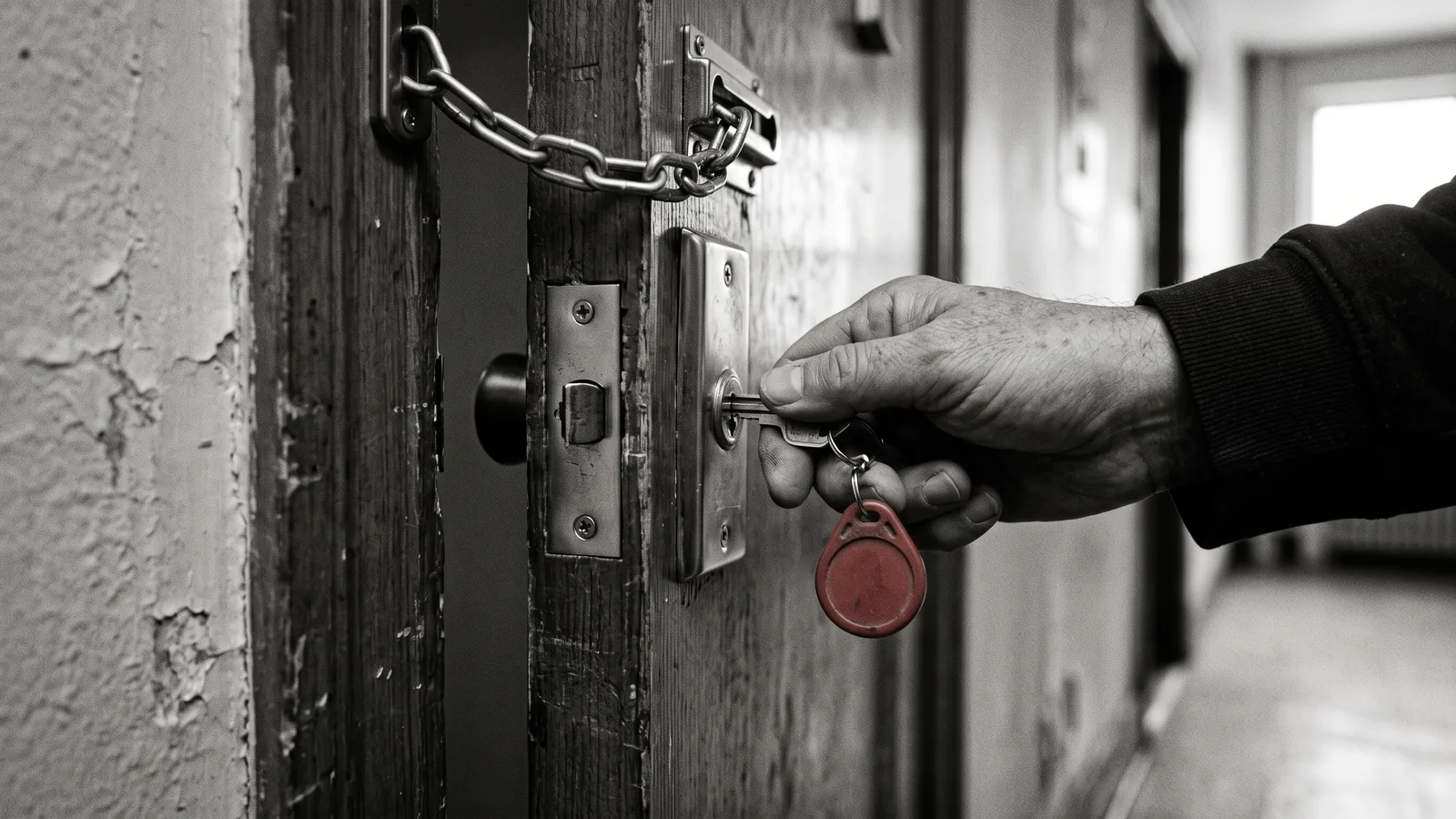
Let's start with the substance of the law, without jargon. In Québec, a tenant who holds a valid lease has the right to occupy their dwelling and to access it freely, as long as they have not left of their own accord or a decision of Québec's rental board (the TAL) has not ended their right. This right does not depend on the tenant's day-to-day conduct : even a tenant who owes rent keeps access to their dwelling until a tribunal decides otherwise. Preventing that access — by changing the lock, removing the key, blocking the door — amounts to taking back the dwelling without right and without a judgment.
Private justice does not exist in rental law
The principle that explains everything is this : no one may take the law into their own hands. It is not a slogan ; it is the foundation of the system. A landlord who believes their tenant is not meeting their obligations has one remedy, and only one : to go to the tribunal. They cannot decide on their own that the lease is over, nor carry out a departure on their own. It is the TAL that establishes the end of the lease, and it is a bailiff, armed with a judgment, who carries out the eviction if need be. The landlord never, at any moment, has the power to evict with their own hands. Changing the lock is precisely seizing that power one does not have.
An interference with the peaceful enjoyment of the premises
Beyond the illegal eviction itself, changing the lock violates another fundamental right of the tenant : the right to peaceful enjoyment of their dwelling. The landlord has an obligation to provide that enjoyment and not to interfere with it. By locking the tenant out, they do exactly the opposite : they turn the dwelling into a source of conflict and deprive the tenant of its use. When the act is also aimed at forcing a departure, it can be classified as harassment, a concept the law takes very seriously and that opens the door to additional penalties.
Why some landlords get to that point
It would be easy to say that those who do this are bad landlords. The reality is more nuanced : most are ordinary people, pushed to the brink by a situation that drags on. Understanding why one gets to that point is exactly what helps you avoid falling into it.
The perceived slowness of remedies
The first reason is frustration with delays. When a tenant stops paying, the landlord has to open a file, wait for a hearing, obtain a judgment, then, if necessary, hire a bailiff. Meanwhile the rent does not come in, but the mortgage, the taxes and the insurance keep running. In the face of this very real financial pressure, changing the lock looks like an "instant" solution. Except it solves nothing : it adds a second file, this time against yourself, on top of the first.
The sense of injustice
The second reason is emotional. The landlord feels, often rightly, like the one bearing the brunt : it is their property, it is their money, and they are the one absorbing the unpaid rent or the damage. This sense of injustice, legitimate to begin with, becomes dangerous when it turns into "I'm going to take back what's mine." The dwelling belongs to the landlord, yes — but the right of occupancy belongs to the tenant as long as the lease holds. Confusing the two is the mistake that leads straight to the changed lock.
Bad advice and myths
The third reason is misinformation. "A friend did it and it worked," "after so many days without paying, they lose their rights," "if they're not around, it means they've abandoned the dwelling" : these phrases circulate and they are false. Non-payment does not make the right to remain in the dwelling disappear ; an absence does not amount to abandonment ; and no magic deadline turns a tenant into an occupant without right. Acting on the basis of these myths is acting blind — and paying for having done so.
Key takeaway
The motivations are understandable — delays, felt injustice, bad advice —, but none of them make the act legal. The real answer to these frustrations is not to get around the law : it is to use a route that is faster and risk-free, like the voluntary move-out agreement.
What the law says : the right to remain in the dwelling
To fully grasp the scale of the problem, you have to understand the centrepiece of Québec rental law : the right to remain in the dwelling. This right, set out in the Civil Code of Québec and applied by the TAL, means that a tenant can only be compelled to leave their dwelling in specific cases, provided for by law, and according to a precise procedure. Outside of those cases, they stay home, full stop.
The only real ways out of a lease
Concretely, there are only a small number of legitimate ways to end a tenant's occupancy :
- Voluntary departure — the tenant chooses to leave, at the end of the lease or through a cancellation agreement.
- Repossession of the dwelling — the landlord takes back the dwelling to live in it or to house an eligible relative, with notice, a good-faith reason and compliance with the TAL's deadlines.
- Eviction for major work — subdivision, enlargement or change of use, governed by their own rules.
- Cancellation by the tribunal — the TAL ends the lease for a serious reason : non-payment, repeated lateness, serious disturbances.
You'll notice what appears nowhere on this list : "changing the lock." There simply is no route where the landlord carries out the departure themselves. Even when they are perfectly right on the substance — a tenant who really has stopped paying, for instance —, ending the lease goes through a judgment, and enforcement through a bailiff. Never through their own hands.
Non-payment does not change the rule
This is the most counter-intuitive point, so let's repeat it. A tenant who does not pay keeps their right to remain in the dwelling until a judgment of the TAL cancels the lease. As long as that judgment does not exist, the tenant has the right to enter their home, unpaid rent or not. The right reflex, in that case, is to document the lateness and file an application with the tribunal — not to touch the lock. By locking the tenant out, the landlord gives up the strong position that the non-payment gave them and puts themselves in the wrong. To go further on this specific case, see our guide on the framework for repossession of a dwelling and on voluntary alternatives.
The consequences : what it really costs
Here is the heart of the matter. Many landlords imagine that, in the worst case, they will have to "reopen the door" and the story will end there. In reality, the consequences of changing a lock pile up, and they can far exceed the initial financial stake.
The immediate reinstatement of the tenant
The first consequence, often the fastest, is that the tenant can ask the TAL to order their reinstatement in the dwelling. And the tribunal regularly grants such orders when the lease is still valid. The result is brutal for the landlord : not only does the tenant not leave, but they come back — with a judgment in hand, often on an urgent basis, and a relationship that is now openly adversarial. The act meant to solve the problem has made it worse : the tenant is back, and the balance of power has flipped.
Damages and punitive damages
The second consequence is financial. The illegally evicted tenant can claim damages for the harm suffered : emergency lodging costs, inaccessible belongings, stress, inconvenience. To this can be added punitive damages, specifically intended to sanction a deliberate infringement of the tenant's rights — and a lock change is, by its very nature, a deliberate act. The tribunal assesses the amounts according to the circumstances ; we do not put forward precise figures here, as they vary from one case to the next. But the order of magnitude can easily exceed several months' rent, that is, far more than what the landlord was trying to recover.
The fines set out by law
The third consequence lies in the administrative penalties. Tactics aimed at harassing a tenant to force them to leave — and locking someone out is a classic illustration — are punishable by fines set out by law. We do not quote a precise amount, as the ranges change and depend on the context, but keep in mind that these fines exist, that they add to the damages awarded to the tenant, and that they are not negotiable : they sanction the behaviour itself.
The invisible harm : reputation
The fourth consequence is the one that is hardest to put a number on, and yet the heaviest in the long run : the harm to reputation. These files sometimes become public : a tribunal decision that anyone can read, a newspaper article, a post circulating in tenant and landlord groups. Yet a landlord, like anyone else, has only one name in life. Being associated, once, with an illegal eviction can weigh for a long time : on the trust of future tenants, on business relationships, on peace of mind. No rent savings make up for the loss of a good name.
A realistic scenario (illustrative)
Take a typical case — not a real file, but a chain of events that this kind of situation regularly produces. A tenant runs up two months of unpaid rent. Fed up, the landlord changes the lock during an absence. The tenant files an urgent application with the TAL and obtains their reinstatement : they move back in. They then claim damages for the nights spent at the hotel and the inconvenience, plus punitive damages for the deliberate infringement of their rights. The landlord, meanwhile, still has to settle the question of the unpaid rent separately, which has not moved an inch. Bottom line : the initial problem remains, a second problem was born, and the bill has ballooned. The shortcut only cost time and money.
The variations on the same trap
Changing the lock is the most visible form of the problem, but it has cousins that are just as risky. Many landlords, aware that locking the door is illegal, look for "more subtle" ways to get the same result. Bad idea : the law does not look only at the act, it looks at the intent to force a departure.
Cutting off essential services
Interrupting electricity, water, heating or gas to make the dwelling unlivable is just as wrongful as changing a lock — sometimes more so, because it puts the tenant's safety and health at stake. It is a direct interference with the enjoyment of the premises, and it can amount to harassment. Not touching the door changes nothing : the goal is the same, and so is the penalty.
"Soft" harassment
Multiplying unannounced visits, sending incessant messages, storing materials in front of the door, deliberately delaying repairs, making noise or intimidating : this set of small pressures, taken in isolation, may seem trivial. Added up, with the obvious aim of pushing the tenant to "crack" and leave, it forms a pattern of harassment that the TAL knows how to recognize. Here again, the purpose — forcing a departure outside the legal framework — is what triggers the consequences.
The "abandoned" dwelling : caution
One trap variation deserves a mention : the dwelling that appears empty. A tenant may be travelling, in hospital or temporarily away while still holding their lease and belongings. Assuming abandonment too quickly and changing the lock "since they're not around anymore" can backfire on the landlord if the absence was only temporary. When there is genuine doubt about an abandonment, the right approach is to document the situation and confirm the proper course of action with the TAL or a legal advisor, rather than acting on an assumption.
Key takeaway
The law does not sanction only the changed lock : it targets any tactic meant to force a departure outside the legal framework. Cutting off services, harassing, presuming abandonment : it is the same trap in other forms, with the same consequences.
The legal way to get a dwelling back
Here is the good news, the one that should stay with you from this whole article : there are perfectly legal, and often faster, ways to achieve the goal that changing the lock clumsily aims at. It all depends on what you really want.
If a relative is going to live in the dwelling : repossession
If your real intent is to house an eligible relative — yourself, your spouse, a child, a parent —, the right route is repossession of the dwelling : a proper notice, a good-faith reason, compliance with the TAL's deadlines, and the tenant's right to refuse or challenge. We detail all of this in our dedicated guide, "Repossession of a dwelling in Québec". Beware : repossession is meant to occupy the dwelling, never to empty it to re-rent it at a higher price.
If the tenant is at fault : the TAL, then the bailiff
If the problem is persistent non-payment or a serious disturbance, the route is a proceeding before the TAL : you ask for the cancellation of the lease, you obtain a judgment, and — if the tenant does not leave — you have that judgment enforced by a bailiff. It is longer than a turn of a screwdriver, true, but it is the only route that keeps you on the right side of the law and that produces a departure no one can later challenge.
If you want to recover and optimize : the voluntary move-out agreement
And here, in practice, is what most landlords tempted by the lock actually want : to get back a dwelling frozen far below market, in order to renovate it, re-rent it at its fair value or sell it vacant. For this goal, neither repossession nor a fault-based proceeding is the ideal tool. The tool built for it is the voluntary move-out agreement — cash for keys.
The principle is as simple as it is effective : instead of forcing the departure, you negotiate it. The landlord offers the tenant compensation, and the tenant freely agrees to cancel their lease and leave on an agreed date. Everyone signs a clear agreement. Because both parties agree, there is no challenge, no burden of proof, and no risk of being accused of an illegal act. It is legal, it is voluntary, it is win-win — and it is often much faster than any contentious proceeding. For a tenant whose rent is far below market, an upward renegotiation (cash for raise) or buying back the lease creates value that is frequently counted in the tens of thousands of dollars on the asset. We explain the method step by step in "How to do a cash for keys in Québec" and in our Cash for Keys kit.

Why it takes professionals
You might think a voluntary move-out agreement is "just coming to an understanding with the tenant." In broad strokes, yes. In the details, each step can derail the process if it is poorly handled — and that is where the right support changes everything.
Every detail counts
An agreement that truly protects the landlord means doing several things well at once : assessing the dwelling's dormant value correctly to know how much it is reasonable to offer ; approaching the tenant at the right time and in the right way, never giving the impression of pressure or a threat ; negotiating a compensation that satisfies the tenant without squandering the value recovered ; and drafting a solid cancellation agreement that closes the lease cleanly and leaves no ambiguity behind. A clumsy word, a wording that resembles coercion, a botched agreement : each of these missteps can turn a fine operation into a dispute.
The line never to cross
The most serious risk, in a negotiation conducted alone and under stress, is to slip without realizing it onto the side of illegitimate pressure. A voluntary offer repeated too firmly, a tone that turns into an ultimatum, an allusion to "what will happen" if the tenant refuses : and suddenly a legal agreement takes on the look of harassment. The line between proposing and coercing is sometimes thin, and it is precisely experience that makes it possible to hold it. Doing things properly is not just about knowing the law : it is about knowing how to speak, when, and in what words.
Your name is worth more than a shortcut
That is the whole logic of Opti Loyer. You only have one name in life, and a landlord's reputation is a valuable asset you don't gamble on a whim. Our job is to recover and optimize dwellings through voluntary move-out agreements, in keeping with the TAL, so that you never have to choose between profitability and legality. The initial audit is free : together we look at the dormant value your building holds, with no commitment. And our model is pay only for results — you pay only if the agreement is reached and you obtain the outcome. The financial risk of the process does not rest on you ; nor on us, because we know what we are doing.
The temptation to change the lock always arises from a real problem : a dwelling that isn't bringing in what it should, a difficult tenant, patience worn thin. The problem is real, the exasperation is legitimate — but the lock is never the answer. It turns a manageable dispute into a costly fault, it reverses the roles, it puts a name at risk. The right answer exists, it is legal, and it is often faster : the voluntary move-out agreement. Repossession to occupy, a proceeding before the TAL for fault, a voluntary move-out agreement to recover and optimize. In every case : never the lock.
This content is provided for informational purposes and does not constitute legal advice. The TAL's rules, deadlines and penalties change — confirm the terms in force or consult a legal advisor before acting.