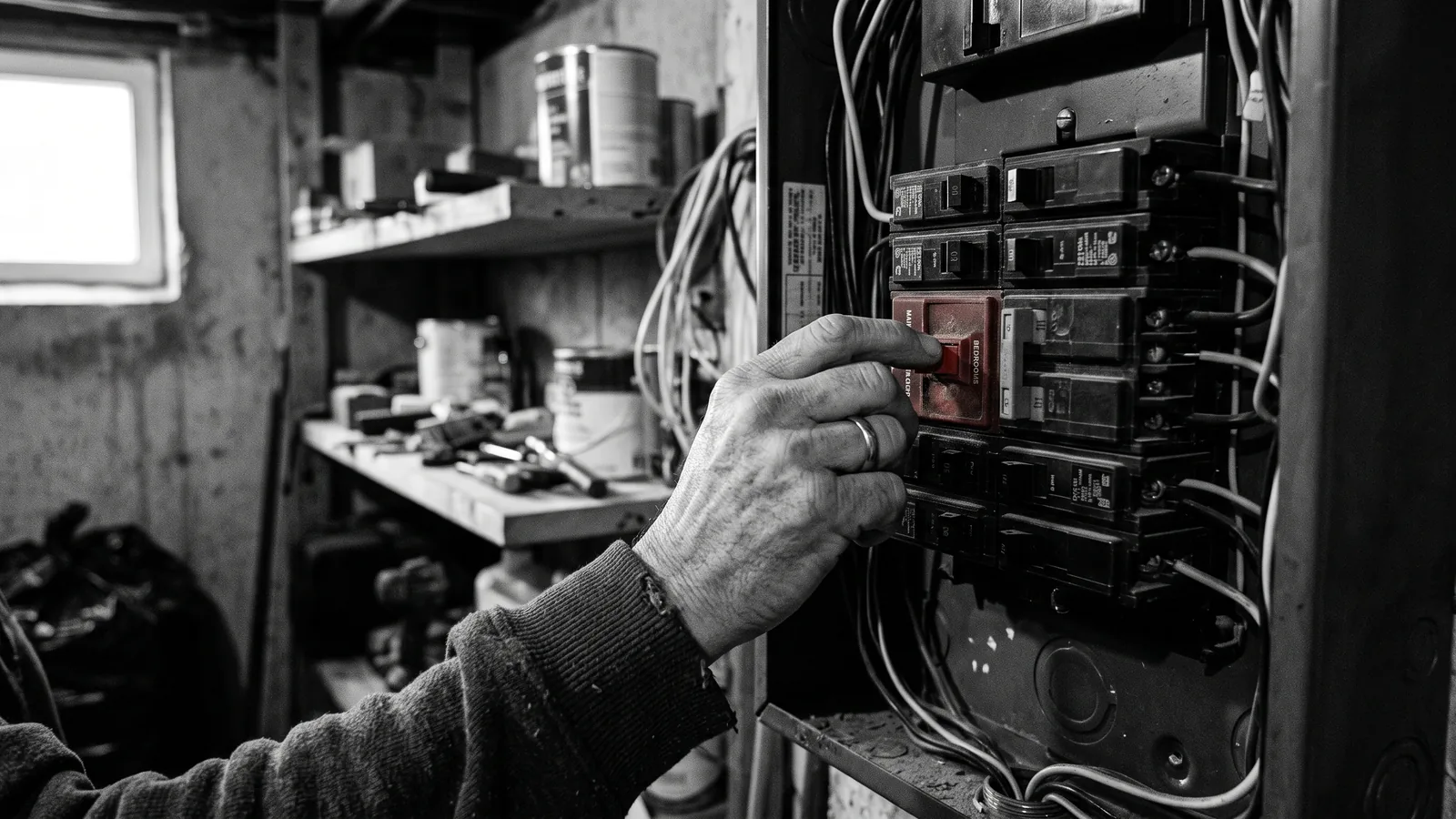
It is a scene that regularly makes the headlines : a tenant recounts spending part of the winter without heat, having their hot water cut off, or coming home one evening to find the electricity meter disconnected. Behind these stories, there is almost always the same script : a landlord in a hurry to recover a dwelling locked below market, who decides to "force" the departure rather than follow the legal channels. The problem is that cutting off a tenant's heat, water or electricity is illegal in Quebec, potentially dangerous, and it almost always backfires on the person who does it. This article explains why these practices happen, why they end up before the Administrative Housing Tribunal (the TAL), what they can cost, and above all the legal way to reach the same objective — getting a dwelling back — without landing in trouble.
In this article
- Why landlords resort to this
- What the law says : it's prohibited, full stop
- The forms it takes (beyond the cut-off)
- Why it is also dangerous
- The consequences : what it really costs
- The legal way to get a dwelling back
- Why "doing it right" takes pros
- The Opti Loyer approach : pay only for results, zero risk
Why landlords resort to this
Let's start by understanding, without judging, how an otherwise reasonable landlord ends up cutting off a service. In the vast majority of cases, it is not cruelty : it is exasperation mixed with bad arithmetic. A dwelling rented well below market, a tenant who has done nothing wrong and therefore has no reason to leave, a repossession that is impossible because no relative wants to live there, a case that drags on : the landlord feels trapped. Every month they see the gap between what they collect and what the dwelling would be worth, and they end up looking for a shortcut.
The shortcut often takes the form of an appealing but false line of reasoning : "if the dwelling becomes uncomfortable, the tenant will eventually leave on their own." The heat is cut off "while a repair is done" that never ends, a water leak is left unrepaired, the landlord "forgets" to pay the electricity bill that is in their own name. The idea is to make the premises unpleasant enough to trigger a "voluntary" departure, without ever having to go before a tribunal.
The scheme that looks clever — and isn't
On paper, the math looks airtight : no proceeding to file, no delays, no agreement to negotiate, no compensation to pay. You "save" the time and money of the legal process. Except that this calculation completely ignores the other side of the scale : the tenant is far from without recourse. They have solid rights, tribunals that enforce them, and — a detail that landlords in a hurry underestimate — the cut-off itself becomes the best evidence against its author.
In other words, the landlord who cuts off a service believes they are gaining an advantage ; in reality, they are manufacturing the exhibit that will get them condemned. A tenant who, the day before, had no grievance suddenly finds themselves with an airtight case. It is the classic reversal : the party who was in the right — a landlord whose only "problem" is a rent that is too low — becomes the party at fault.
Key takeaway
Cutting off a service almost never comes from gratuitous ill intent, but from bad arithmetic : you think you're saving time and money. In reality, you're manufacturing the evidence that will condemn you and turning a winnable case into one that's lost before it starts.
What the law says : it's prohibited, full stop
Quebec rental law is unambiguous on this point. The tenant has the right to the peaceful enjoyment of the premises for the entire duration of the lease, and the landlord has the corresponding obligation to provide that enjoyment. This means, very concretely, that the landlord must keep the dwelling in a good state of habitability and provide the services included in the lease. Heat, water, landlord-supplied electricity, hot water : when these services are part of what the tenant is entitled to, interrupting them to apply pressure is a direct violation of the lease and of the law.
You have to grasp the principle that underpins everything else : in Quebec, no one may take the law into their own hands. Even when a landlord is right on the merits — a tenant behind on rent, a lease they want to end, a legitimate renovation project — they can never impose their will by force or by deprivation. The only way to end a lease against the tenant's will runs through the Administrative Housing Tribunal. Cutting off a service short-circuits this fundamental principle ; it is precisely what the law prohibits.
Peaceful enjoyment and the obligation of habitability
The notion of peaceful enjoyment is broader than people think. It is not limited to silence or the absence of disturbances from neighbours : it encompasses the right to use the dwelling normally for what it is meant for — to live in it, heat it, cook in it, wash in it. A dwelling with no heat in January, no running water or no electricity is simply not habitable. By depriving the tenant of these elements, the landlord fails in their most basic obligation and infringes a right that the law protects vigorously.
This infringement opens several recourses to the tenant, which we detail further on : having the service restored, obtaining a rent reduction for the period concerned, claiming damages, and — when the act is intentional — punitive damages. The mere fact that the deprivation is deliberate makes the situation worse in the tribunal's eyes.
Harassment is specifically prohibited
The law goes even further : it expressly prohibits a landlord from harassing a tenant in a way that restricts their right to peaceful enjoyment of the premises or leads them to leave the dwelling. Cutting off services falls squarely within this definition, but harassment is not limited to it. A series of more discreet gestures — repeated visits, veiled threats, repairs endlessly postponed, intimidation — can be recognized as harassment even without a dramatic cut-off. What the tribunal looks at is the objective being pursued : pushing the tenant out through underhanded means.
The forms it takes (beyond the cut-off)
Cutting off heat, water or electricity is the most visible form, but the same prohibited logic comes in several variations. Recognizing them helps you understand where the red line lies — and to realize that you can cross it without even touching the meter.
- Interrupting an essential service — heat, water, hot water, electricity supplied under the lease — under any pretext, or by "forgetting" to pay a bill in the landlord's name.
- Changing the locks or otherwise preventing the tenant from entering their home.
- Removing the tenant's belongings or emptying the dwelling without a decision from the tribunal and without a bailiff.
- Deliberately leaving a repair unfinished — a leak, a breakdown, a faulty heating system — to make the premises uninhabitable.
- Multiplying intrusions and intimidation — incessant visits, threats, repeated pressure — to wear the tenant down.
All of these manoeuvres share the same flaw : they aim to obtain, through coercion or deprivation, a result that only an agreement or a tribunal decision can legitimately produce. The common thread is the intent to push the tenant out without going through the rules.
Forced repossession
The legal term that covers several of these acts is forced repossession : taking back the dwelling by your own means rather than through a tribunal decision. It is strictly prohibited. Even if the lease is over, even if the tenant "should" have left, the landlord cannot take back the premises by force. An eviction can only be ordered by the TAL and carried out only by a bailiff. Anything that short-circuits this chain — locks, cut-offs, unauthorized removal — is an illegal forced repossession, with the consequences that come with it.

Why it is also dangerous
Illegality is only half the problem. Cutting off an essential service is not only contrary to the law : it is concretely dangerous, and that danger turns a civil dispute into something far more serious.
A real risk to health and safety
Depriving a dwelling of heat in the depths of a Quebec winter is not a mere inconvenience : it is a risk to health, especially for children, the elderly or vulnerable people. A water cut-off deprives people of basic hygiene. An electricity cut-off knocks out the refrigerator, cooking, sometimes smoke detectors or medical devices. And when a tenant, deprived of central heating, falls back on makeshift solutions — overloaded space heaters, a stove left running — the risk of fire or carbon monoxide poisoning becomes real. An act carried out to "make someone leave" can thus end in tragedy.
When civil tips over into penal
It is precisely this potential for danger that pushes the case into another category. As long as we stay within the rental dispute, we are talking about damages and restoration of the service. But the moment there is endangerment, blatant intimidation or serious consequences for a person, the situation can take a far more serious turn, with sanctions in play. The landlord who thought they were applying a little pressure then finds themselves exposed well beyond what they imagined. The ratio between the hoped-for "gain" and the risk incurred becomes completely disproportionate.
The consequences : what it really costs
Let's turn to what should deter any rational landlord : the real price of these practices. Not the moral price, but the concrete, quantifiable price that makes the shortcut almost always cost more than the legal process it claimed to avoid.
1. The dispute at the TAL — fast and unfavourable
The tenant whose service is cut off does not stay passive. They bring the matter before the Administrative Housing Tribunal, often quickly, sometimes on an urgent basis when their health or safety is at stake. The tribunal can order the immediate restoration of the service. And there, the landlord is in a position of maximum weakness : they have to justify an indefensible act. The case they thought they were avoiding, they not only triggered — they walk into it with the worst possible role.
2. Damages and punitive damages
The tenant can claim a rent reduction for the period without the service, damages for the disruption, inconvenience and stress suffered, and — this is where the bill climbs — punitive damages when the infringement of their rights is intentional. And cutting off a service to apply pressure is, by definition, intentional. Punitive damages are not meant to compensate the tenant : they are meant to punish the conduct and discourage it from happening again. This is exactly the kind of behaviour they target.
3. Fines and sanctions
On top of the civil dimension comes a dimension of sanctions. Harassing a tenant and attempts at illegal eviction can give rise to fines. We do not state a specific amount here — the scales change and depend on the circumstances — but the important thing to remember is that there is a punitive component distinct from the damages paid to the tenant. The landlord can therefore be hit on two fronts : compensate the tenant and be sanctioned for the conduct itself.
4. Reinstatement of the tenant
Here is the consequence that makes the whole manoeuvre look ridiculous : if the tenant was pushed out by the cut-off or by a forced repossession, they can be reinstated in their dwelling. The landlord then ends up exactly where they started — the tenant is back — but with, on top of that, damages to pay, a damaged reputation and a relationship that has turned toxic. All for nothing. The dwelling they wanted to free up is occupied again, and by a tenant who now has every reason to be wary and to document the slightest gesture.
5. Reputation and the media
This last point is often the most costly, and the most underestimated. These stories make the headlines. A tenant with no heat in winter is a ready-made news report ; tenant-advocacy groups relay these cases, social media amplifies them, and the landlord's name can end up publicly associated with this kind of practice. For a private individual as much as for a company that owns several buildings, it is a lasting stain. You can fix an electricity meter in an hour ; a reputation is another matter.
Key takeaway
The illegal shortcut stacks up the bills : forced restoration of the service, rent reduction, damages, punitive damages, fines, reinstatement of the tenant and reputational harm. You end up paying more — and still find yourself with the dwelling occupied.
The legal way to get a dwelling back
The good news is that the original objective — recovering a dwelling locked below market — is perfectly legitimate, and there are legal routes to get there. The problem was never the objective ; it's the means. Here are the real options, depending on the situation.
If the tenant is at fault : the recourse to the TAL
When a tenant does not pay their rent or causes serious disturbances, the answer is never a cut-off : it's a proper proceeding before the TAL, which can authorize termination of the lease and eviction according to the rules. It is slower than a cut-off, but it's the only route that holds up — and it leaves the landlord on the right side of the case. We cover this scenario in our article on repossession of a dwelling and in our guides on problem tenants.
If a relative is going to live there : repossession of the dwelling
If an eligible relative is genuinely going to live in the dwelling, repossession is possible : written notice, delays, good faith. But be careful : it only serves to occupy the dwelling, never to empty it in order to re-rent it at a higher price. Using a false repossession, like cutting off a service, is a bad-faith practice that exposes you to the same consequences. To fully understand this mechanism and its limits, see our complete guide : "Repossession of a dwelling in Quebec."
If you simply want to recover and optimize : the voluntary agreement
This is the most common case, and it's here that the solution is most elegant. If your real objective is to recover a dwelling frozen below market in order to renovate it, re-rent it or optimize it, the appropriate tool is the voluntary agreement — the cash for keys. The principle is simple and perfectly legal : you offer the tenant to end the lease and leave on an agreed date, in exchange for compensation. The tenant is never forced ; they agree because they find it in their interest. And since everyone agrees and signs a clear agreement, there is no cut-off, no pressure, no dispute, no burden of proof and no risk of condemnation.
There is also a variant when you want to keep the tenant but restore a fair rent : the cash for raise, an agreement in which the tenant accepts a rent revision in return for a negotiated benefit. In both cases, we are in the logic of a mutually agreed arrangement, a world away from a cut-off. To go further, our guides "Cash for keys in Quebec" and "How to do a cash for keys" detail the method, the calculation and the drafting of the agreement.
The same objective, two opposite paths
The prohibited path : you cut off the heat "while a repair is done" to wear the tenant down. Likely result : a complaint to the TAL, the service restored by force, damages, punitive damages, a possible fine, the tenant reinstated, a damaged reputation — and the dwelling still occupied.
The legal path : you sit down with the tenant and offer them a move-out agreement with compensation. Result : the tenant agrees, signs, leaves on the agreed date ; the dwelling is freed up cleanly, brought up to standard, re-rented at its fair value. No dispute, no stain on your record.
Why "doing it right" takes pros
You might think a voluntary agreement is "just a conversation." In reality, every detail matters, and a single misstep can derail the whole process — or even make it look, in a tribunal's eyes, like illegal pressure. That is exactly why how you do it matters as much as the intention.
A thinner line than you'd think
Between a legitimate move-out offer and illegal pressure, the line sometimes comes down to the way things are presented. The same proposal can be received as an appealing opportunity or as a disguised threat, depending on the tone, the timing, the words used and the context. A clumsy landlord, even in good faith, can unintentionally give the tenant — or the tribunal — the impression that they are applying coercion. Conversely, a professional approach knows how to stay on the right side of the line, to offer without ever threatening, and to document it.
The details that derail a process
Each of these points, mishandled, can be costly :
- The proof of good faith — every exchange must show that the tenant is acting freely, without pressure or deprivation.
- The amount and structure of the compensation — offering too little makes the agreement fail ; structuring it poorly creates problems later.
- The drafting of the agreement — a poorly written lease termination can be contested, reopened or found invalid.
- Absolute respect for services and comfort throughout the negotiation — the slightest cut-off, the slightest "oversight" on a repair destroys the whole process.
- The timing and tone of communications — too insistent, too frequent, and the offer tips over into harassment.
That's a lot of finesse for someone handling this alone, often in the grip of exasperation. And it's precisely under these conditions — impatience, emotion, ignorance of the rules — that illegal acts are born. Entrusting the process to professionals means taking the emotion out of the equation and replacing improvisation with a proven method.

The Opti Loyer approach : pay only for results, zero risk
At Opti Loyer, our business is precisely to help landlords recover and optimize their dwellings through voluntary agreements, in strict compliance with the TAL. Where the illegal shortcut exposes you to everything we have just described — damages, fines, reinstatement, a damaged reputation — our approach aims at the opposite : a clean, documented and unassailable outcome.
Concretely, we negotiate an agreement with the tenant in which they genuinely find their interest and which they accept freely — never under coercion, never through the deprivation of a service. We take care of everything : assessing the dormant value of your dwelling, the strategy, approaching the tenant, drafting the agreement, documenting the good faith. The landlord, for their part, keeps their hands clean and their mind at ease.
A model that puts the risk on our side
Two things set our offer apart. First, the initial audit is free : we look together at the untapped value your building holds, with no commitment. Second, the model is pay only for results : you pay only if the agreement is reached and you get the outcome. The financial risk of the process therefore does not rest on you. Compare that to the "cost" of a cut-off service : there, it is you who bears all the risk — legal, financial and reputational — and most often for nothing.
For a dwelling locked far below market, recovering the premises cleanly, bringing them up to standard and re-renting them at their fair value frequently creates value counted in the tens of thousands of dollars on the asset. There is no rational reason to chase that gain through an illegal and dangerous means when a legal route, with no risk and paid only for results, exists.
Want to get a dwelling back — without taking any risk ?
Forget the shortcuts that end up at the TAL. We recover your dwelling through a voluntary agreement, legally, while protecting your reputation. Free audit, and you pay only if it works.
See the Cash for Keys service → Request my free analysis →Let's recap, because the stakes deserve to be clear. Cutting off a tenant's heat, water or electricity — like changing the locks, removing their belongings or harassing them — is illegal in Quebec and often dangerous. These acts almost always backfire on their author : a dispute at the TAL, the service restored by force, damages, punitive damages, fines, reinstatement of the tenant and a damaged reputation. Worst of all, they fail to achieve their goal : the dwelling often ends up still occupied, but by a wary tenant and a condemned landlord. The objective — recovering a dwelling locked below market — is nonetheless legitimate ; there are legal routes to reach it, starting with the voluntary agreement. What remains is to carry it out methodically : that is where professionals make all the difference. And never forget : you only have one name in life ; you don't gamble it on a shortcut.
This content is provided for informational purposes and does not constitute legal advice. The TAL's rules, sanctions and delays change ; verify the terms in force or consult a legal advisor.