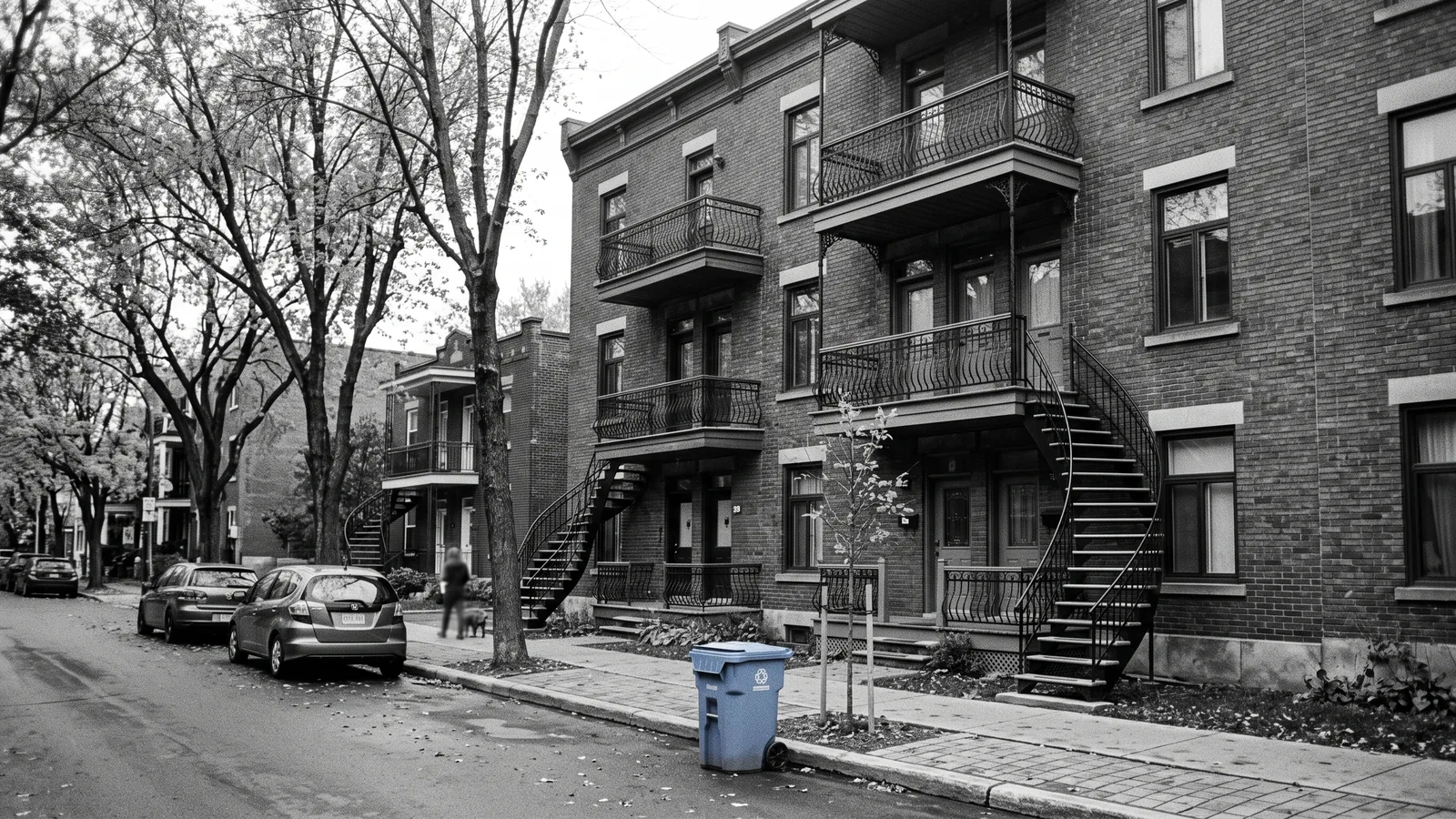
Yes: you can increase your rental income without renovating, legally. Two levers are enough — a negotiated rent increase the tenant freely accepts, or a paid voluntary departure ("cash for keys") followed by re-letting at market price. The value you recover is the rent gap itself, not the bricks or the construction. A unit $500 below market is $6,000 a year waiting to be recovered — with zero construction.
In this article
Two legal levers, zero renovation
Most landlords believe you have to renovate to justify an increase. That's false. In Québec, two perfectly legal mechanisms let you bring a unit back to its market value without hanging a single sheet of drywall:
- The negotiated rent increase — the tenant willingly accepts an increase above the usual indexation, in exchange for a clear benefit.
- The paid voluntary departure (cash for keys) — you pay the tenant compensation to leave, then re-rent the vacant unit at market price.
In both cases, nothing is imposed and nothing is renovated. You're not capturing the value of a construction project: you're capturing the gap between the current rent and the market rent, which already exists, frozen inside your building. That's the heart of rental income optimization — and the reason "without renovating" is often the fastest and most profitable path.
Key takeaway
A rent increase doesn't need work to be valid: it needs the tenant's consent, or a unit that has become vacant again. Both are obtained through a voluntary agreement — no permit, no construction, and no trip to the TAL.
Lever 1 — The negotiated increase the tenant accepts
A tenant can accept almost any rent increase, as long as they do so freely. The law governs what the TAL can impose if the tenant refuses, but it never prohibits a mutual agreement. If the tenant consents in writing to an increase, that increase is valid — even when it exceeds the indexation the tribunal would have set.
Why would a tenant accept? Because you offer something in return: a longer lease that gives them security, a small adjustment they wanted, some flexibility on dates, or simply a calmer relationship and a clear settlement. This is the approach we call cash for raise: a win-win agreement where the increase is accepted, never forced.
No renovation is required. You don't have to demonstrate major work before the TAL, because there is no dispute to settle: the signed agreement stands on its own. That's what makes this lever quiet, fast, and frictionless when it's handled well.
Lever 2 — The paid voluntary departure, then re-let at market
When the rent gap is too large to be closed by a simple increase, the second lever takes over: cash for keys. You pay the tenant compensation to end the lease voluntarily, then re-rent the vacant unit at the price the market commands today.
Here again, no construction is needed. The unit can be re-rented as is: it's the act of bringing it back to market, not renovating it, that unlocks the value. A coat of paint and a cleaning are often enough. The compensation is freely negotiated; no legal scale sets its amount, and an offer that's generous for the tenant stays tiny next to the value it releases.
The real value is the rent gap — not the bricks
Here's the principle that makes both levers so profitable: the value of an income property depends on the net income it generates, not on its finish. The formula used by buyers, appraisers, and lenders is simple:
The cap rate (capitalization rate) expresses the return the market expects. At a 5% cap rate, each additional dollar of annual net income multiplies value by 20 (since 1 ÷ 0.05 = 20).
The direct consequence: every $100 of rent recovered per month is worth roughly $24,000 in property value at a 5% cap rate. Recovering a rent gap therefore injects tens of thousands of dollars into your asset — without spending a cent on materials, and without the delays, permits, and surprises of a construction project. To dig into the math, read "Below-market rents: the hidden fortune in your building."
Example: $500 below market, $6,000 a year recovered
A unit rented at $1,000 would fetch $1,500 at market. The gap is $500 per month, or $6,000 per year in additional income — without a single renovation.
At a 5% cap rate, that gap creates: $6,000 ÷ 0.05 = $120,000 in property value once the rent is raised, whether through an accepted increase or through cash for keys followed by re-letting.
No permit, no contractor, no unit emptied for work: just the rent gap, captured by agreement. That's why a savvy landlord often prefers to negotiate rather than renovate.
And the calculation is conservative: it counts only one unit. In a building where several units lag below market, the effect compounds, and the value created runs into hundreds of thousands of dollars — still with no construction.
"Without renovating" is not a renoviction
You have to be crystal clear on this, because the confusion is costly. Increasing your income "without renovating" through a voluntary agreement is the exact opposite of a renoviction — evicting a tenant under a false renovation pretext to re-rent for more. A renoviction is illegal, risky, and increasingly severely punished by the TAL, with damages climbing year after year.
The difference comes down to one word: consent. A renoviction imposes a departure under a pretext; our two levers rest on the tenant's informed agreement, with a real benefit in return, signed knowingly. And precisely because they invoke no work, these levers don't have to justify major renovations before the tribunal either: there's nothing to prove, because there's no dispute.
Where to start
The first step isn't to knock on the tenant's door: it's to measure the gap. What's the true market rent for the unit? What is the monthly gap worth, capitalized? Which lever fits — an accepted increase, or cash for keys? Without these numbers, you're negotiating blind; with them, you know exactly what margin exists and what offer stays highly profitable.
That's precisely what we do at Opti Loyer, as part of our rent optimization services. The initial audit is free and the model is pay only for results: you pay only if the agreement closes and the result is there. The financial risk of the process doesn't rest on you.
Raising your rental income without renovating is neither a sleight of hand nor a grey area: it's a legitimate optimization, grounded in the rent gap already present in your building and in the tenant's consent. Done well, it turns a building running at half speed into a fully productive asset — without a single swing of the hammer.
This article is provided for informational purposes and does not constitute legal advice. The TAL's rules evolve — always confirm the applicable terms or consult a professional. All of Opti Loyer's processes are voluntary and comply with the residential housing legislation and Québec's Civil Code.