
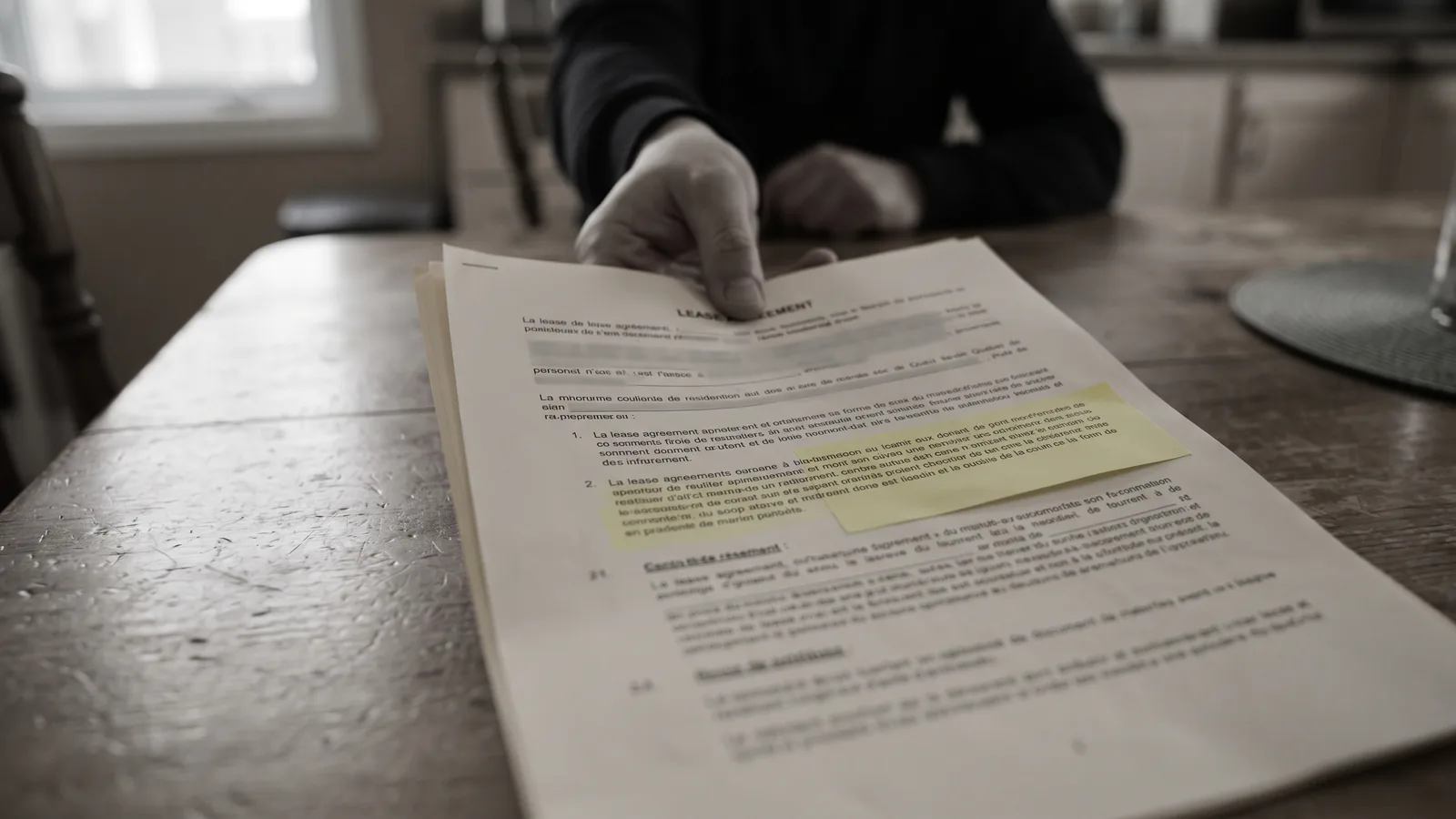
In the spring of 2026, a report by La Presse made headlines by describing a practice as widespread as it is illegal: landlords having their tenants sign documents by which the tenants supposedly waive their legal remedies. In plain terms, the tenant is asked to promise in advance that they will not sue, will not contest anything, will not go to the tribunal. The phrase used to sum up the logic is striking: “divide and conquer.” Approach tenants in isolation, get their signature, and thereby neutralize their ability to defend themselves. The catch is that this strategy rests on a legal illusion. In Quebec, a tenant simply cannot waive, in advance, the rights the law grants them. A paper signed under these conditions is worth nothing — and the process surrounding it can cost the person who orchestrated it dearly.
In this article
The facts: what made headlines
According to the report, landlords allegedly presented their tenants with documents to sign, drafted so as to make them give up their remedies. The content varies from one case to another, but the storyline is the same: the tenant would agree not to file a complaint, not to contest a landlord's decision, or not to go before the Tribunal administratif du logement (TAL, Quebec's rental board). In other words, they would waive in advance the right to defend themselves, before even knowing what is in store for them.
The phrase that struck a chord — “the goal is to divide and conquer” — captures the mechanism of the manoeuvre well. Rather than face a building full of tenants who might help one another, compare their situations and form a united front, they are approached individually. To each one, the signature is presented as a formality, a reasonable gesture, sometimes paired with a perk or a quiet dose of pressure. Isolated and poorly informed, a tenant can feel obliged to sign — especially if they fear for the renewal of their lease or for the peace in their home.
A word of caution is needed here: these are allegations reported by the media, and each individual situation would have its own circumstances. But the legal principle at play is not a matter of allegation. It is well established and it is simple: in Quebec, you cannot make a tenant waive public-order rights. That is what we will look at — and it is what dooms the strategy, whatever the initial intentions may have been.
Key takeaway
The manoeuvre consists of having tenants sign, one by one, a waiver of their legal remedies. It banks on isolation and lack of knowledge. But a public-order right is not lost through a signature: a waiver obtained this way is worthless, and the process can backfire on the landlord.
Why it's illegal: you can't waive public order
To understand why these waivers are worthless, you have to grasp a central idea of Quebec housing law: certain protections granted to the tenant are a matter of public order. This means they apply regardless of what the lease says, and no clause can depart from them. The legislator made this choice because, in the relationship between a landlord and their tenant, the latter is generally the more vulnerable party: they need a roof over their head, and they could be tempted — or pushed — to give up their rights in order to get or keep it. Making these rights untouchable means preventing anyone from wresting them away by contract.
The principle: a clause that departs from the protections is “without effect”
The Civil Code of Quebec (C.c.Q.) is explicit on this point. A residential-lease clause that departs from the protections granted to the tenant is without effect (see in particular article 1893 C.c.Q.). “Without effect” is a strong term: it means the clause is deemed never to have existed. It does not bind the tenant, no matter whether they read it, understood it, or signed it in their own hand. A signature does not turn an illegal clause into a valid one; it merely puts a name on a text that has no effect.
A general waiver of remedies falls squarely within this logic. Promising not to go to the TAL, not to contest a rent increase or not to claim what the law grants is precisely to depart from the public-order protections. The tenant therefore keeps all of their remedies, as if the document had never been signed. This is the first reason the strategy fails: it does not buy the legal security it claims to buy.
The right to remain in the dwelling
At the heart of these protections lies the right to remain in the dwelling (article 1936 C.c.Q.). Every tenant has a personal right to stay in their home as long as they meet their obligations: it is one of the pillars of Quebec rental law. A tenant cannot be forced to leave simply because a landlord wishes it, nor because they were made to sign a paper to that effect. Making a tenant waive this right, or leading them to “accept” a departure they did not truly choose, amounts to circumventing a protection that the law places beyond the reach of lease clauses.
The prohibition on harassment
There is more. The way these signatures are obtained can, on its own, be illegal. The Civil Code prohibits the landlord — and any other person — from harassing a tenant in a way that restricts their peaceful enjoyment of the premises or induces them to leave the dwelling (article 1902 C.c.Q.). Approaching tenants one by one, applying pressure, coming back again and again, hinting that refusing will have consequences: depending on the circumstances, these acts can amount to harassment. And harassment does not need to be loud or crude to exist; a polite, methodical campaign to extract waivers can very well fall under the prohibition.
Good faith, finally, runs through all of Quebec civil law. A landlord who stages a waiver knowing — or having reason to know — that it is worthless, for the sole purpose of discouraging their tenants from defending themselves, acts contrary to the good faith expected of parties to a contract. It is a factor the tribunal can take into account, and one that aggravates how the process is viewed.
This mechanism turns up every time a landlord tries a shortcut to empty a dwelling. Whether the pretext is a fake renovation, an invented repossession or a forced waiver, the legal result is the same: the law looks at the reality, not the label. We explain it in detail in our analyses of bad-faith repossession and illegal renoviction in Quebec.
The consequences for the landlord
You might think a landlord who tries this kind of manoeuvre risks, at worst, seeing their waiver ignored. That underestimates the problem. The consequences stack up, and they can turn a supposed gain into a net loss.
1. The waiver protects nothing
The first consequence, and the most immediate: the document produces no effect. The tenant keeps the full set of their remedies. They can contest an increase, report harassment, claim damages or demand that their rights be respected, exactly as if they had never signed anything. The landlord has therefore spent energy, time and sometimes money to obtain a “security” that does not exist. Worse: they may have convinced themselves that they were protected, and they will act on that false certainty — until the unpleasant surprise.
2. Damages, and possibly punitive damages
If the process involves pressure, intimidation or manoeuvres to push the tenant out, it can be characterized as harassment. Now, harassment of a tenant opens the door to damages — for the harm suffered — and to punitive damages, whose very function is to sanction and deter this kind of conduct. A tenant does not need to have left their home in order to act; they can go to the TAL during the lease. The amount depends on the circumstances, and we don't put a figure on it here, but the important thing is to understand the mechanics: the more deliberate the manoeuvre, the greater the exposure.
3. The collective “snowball” effect
The “divide and conquer” strategy has a fatal flaw: it only works as long as the tenants stay isolated. The moment they compare their documents — often identical — the logic reverses. What was meant to weaken them becomes proof of how systematic the process was. A whole building's worth of identical waivers, obtained the same way, paints a far heavier picture than an isolated incident. The division the landlord sought turns into cohesion against them.
4. Reputation and the media
Finally, there is the court of public opinion. As the La Presse report illustrates, these practices eventually come to light. A landlord named, or even simply recognizable, in an article devoted to illegal manoeuvres against tenants pays a price that appears in no judgment: lost trust, a damaged relationship with the neighbourhood, a label that sticks. In a market where a landlord's or manager's reputation matters for attracting and keeping good tenants, that cost is very real — and it is not wiped away by a cheque.
What should have been done: the voluntary route
Behind these manoeuvres there is almost always a perfectly understandable objective: recover a dwelling, put an end to a difficult lease, or bring a rent that has been frozen far below market back up to level. The problem is not the objective; it is the method. Because for each of these goals there is a legal route, and that route is often faster and safer than the illegal shortcut.
Real consent, not a forced waiver
The whole difference comes down to one word: consent. A forced waiver tries to strip the tenant of rights they cannot give up. A voluntary agreement, by contrast, offers the tenant something they are free to accept or refuse, in exchange for real consideration. In the first case, you circumvent the law; in the second, you work with it. The tenant is not giving up a public-order right: they are choosing, knowingly and to their own advantage, to end their lease.
Cash for keys: the departure agreement, done right
The most direct tool for recovering a dwelling amicably is cash for keys: a mutually agreed arrangement by which the tenant agrees to leave the dwelling on an agreed date in exchange for compensation. It is legal precisely because nothing is imposed: no threat, no waiver spirited away, no right circumvented. The tenant comes out ahead — a sum of money, time, flexibility to find a new home — and the landlord recovers their dwelling cleanly, with no risk of a challenge, since both parties have signed a clear and balanced agreement. A dwelling stuck below market, once recovered this way, can create value that often runs into the tens of thousands of dollars.
This is also the logic of cash for raise, when the goal is to adjust the rent rather than recover the dwelling: you reach an agreement, you document it, you stay within the framework. The lesson is the same as for repossession: the law does not forbid recovering or optimizing a dwelling; it forbids doing so by trampling on the tenant's rights. Do it with their consent, and the process is solid.
What separates a good agreement from a trap
A word of caution, though: a poorly drafted departure agreement can look dangerously like the very illegal waiver you want to avoid. If the agreement is obtained under pressure, if it locks the tenant into clauses that reek of a forced waiver, or if it is so lopsided as to be shocking, it risks being set aside — and reopening the door to harassment. A valid voluntary agreement rests on three things: free consent, real consideration, and clear drafting that respects the TAL framework. That is the line between optimization and illegality.
Key takeaway
The goal — recovering or optimizing a dwelling — is legitimate. The illegal method (making someone waive their rights) fails; the legal method (the voluntary agreement) works. The difference lies in the tenant's real consent and genuine consideration, not in a signature wrung out over a right that cannot be given up.
Why work with professionals
Here is the crux of the problem. The landlords who end up in the headlines are not necessarily bad people: they are often folks who wanted to sort out a frustrating situation themselves, quickly, alone — and who took the wrong path for lack of knowing the right one. The line between a flawless voluntary agreement and a manoeuvre that tips into harassment is thinner than one might think, and a landlord in a hurry crosses it without even realizing.
That is exactly where a specialized intermediary changes everything. At Opti Loyer, we only do voluntary agreements, within the TAL framework. In concrete terms, that means: no forced waiver, no pressure, no clause that could backfire on you. We approach the tenant with an honest proposal, we negotiate compensation that makes sense for them, and we document the agreement so that it holds up. The tenant chooses; the landlord recovers a dwelling with no court file trailing behind.
The model is pay only for results: the initial analysis is free, and you only pay if the agreement is reached and you get the result. The financial risk of the process does not rest on you. Compare that with the illegal shortcut: there, all the risk is on the landlord's shoulders — damages, punitive damages, reputation, wasted time — for a document that, to top it off, does not even protect them. On one side, a risk borne by a partner paid on success; on the other, total risk borne alone for a null result. The choice is not a hard one.

You only have one name
These cases — forced waivers, fake repossessions, disguised renovictions — all tell the same story: a landlord who wanted to save time and lost a great deal of it, in money as much as in reputation. What these shortcuts have in common is that they promise to circumvent the law and end up subject to it. Making a tenant sign a waiver buys nothing: the right stays with the tenant, and the risk stays with the landlord. To that risk you can add exposure to penalties when a manoeuvre crosses certain lines.
The good news is that there is a route that reaches the same objective with none of these risks: the voluntary agreement, done by the book, paid only for results. You only have one name in life; it does not deserve to be gambled on a paper that is worth nothing. Recover your dwelling the right way, and you keep both the value created and your peace of mind.
This content is provided for informational purposes and does not constitute legal advice. The rules and the interpretation of rental law evolve; for your specific situation, verify the applicable terms with the Tribunal administratif du logement, a tenants' association or a legal advisor.