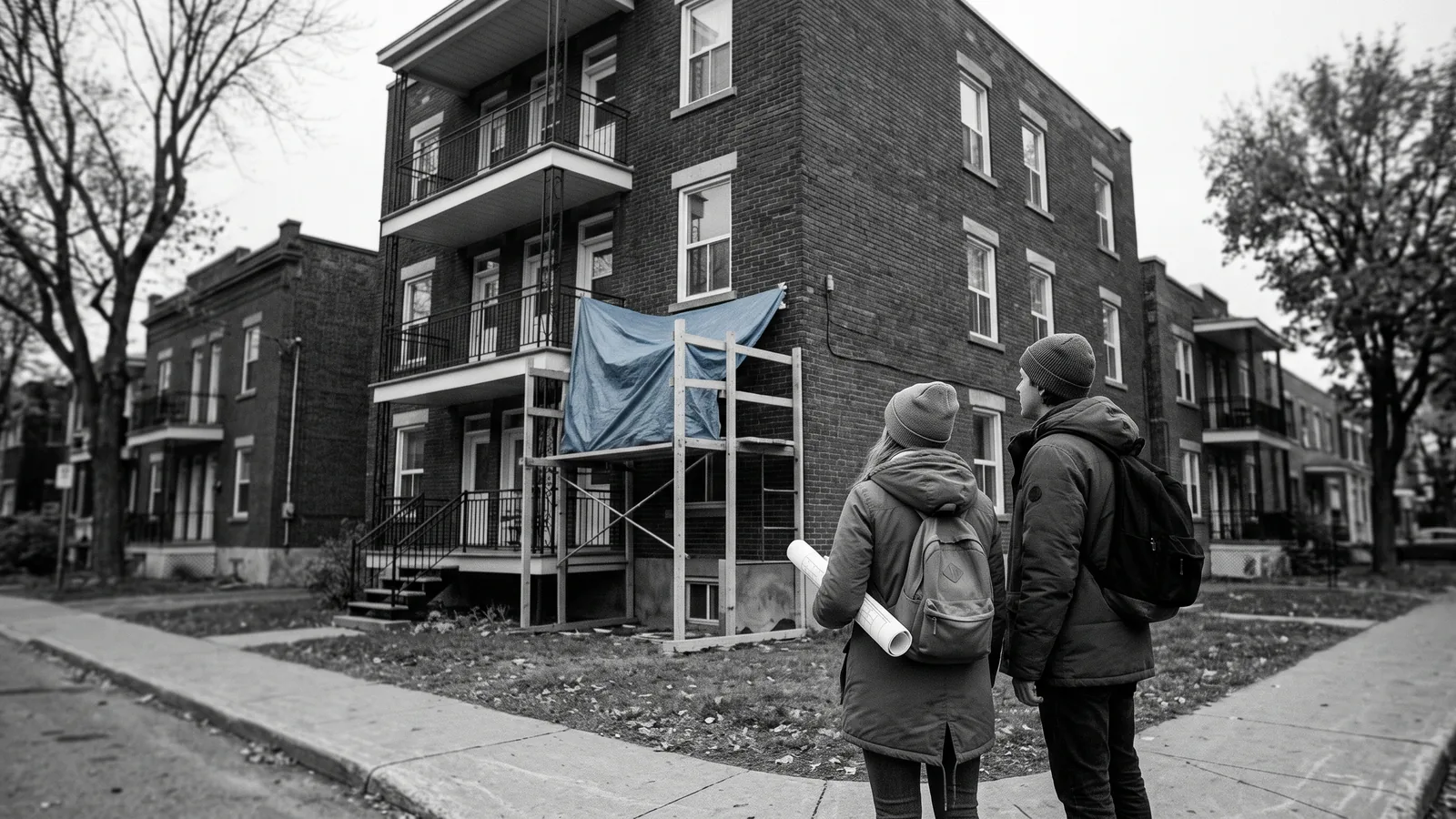
The case is a textbook example. According to the reports, a young couple of real-estate investors, in their mid-twenties, recovered a dwelling by evicting its tenant, renovated it, then offered it as a short-term tourist rental on Airbnb — instead of occupying it as the process had suggested. The catch : the scheme eventually came to light, notably thanks to social media posts. The tribunal ruled in favour of the evicted tenant, journalist Alexie André-Bélisle, and ordered the couple to pay her a sum of roughly $14,000. Even CORPIQ, the main landlords' association in Quebec, distanced itself from this kind of tactic. Here is what this case reveals — and why it should give pause to any landlord tempted to "recover" a dwelling through a shortcut.
In this article
The facts : a repossession that turns into an Airbnb
Let's go over it calmly, based on what has been reported publicly. Two young investors, a couple in their mid-twenties, become the owners of an occupied dwelling. Rather than dealing with the lease in place, they set out to recover the premises : the tenant leaves following a repossession or an eviction. So far, nothing seems abnormal — a landlord sometimes has good reasons to repossess a dwelling.
What follows, however, changes everything. Once the dwelling is vacated, it is renovated, then listed as a short-term tourist rental on Airbnb. In other words, the dwelling is never occupied by the owner or by a relative : it becomes a commercial lodging product. Yet, according to the report, that is precisely the opposite of what the repossession had implied. The gap between the reason invoked to evict the tenant and the actual use of the dwelling is at the heart of the problem.
Instagram, that inconvenient witness
What makes this case juicy — and instructive — is the way it came to light. According to the reports, it was notably social media posts, including on Instagram, that gave the new owners away : photos of the renovated dwelling, marketing of the tourist rental, digital traces hard to erase. The evicted tenant, journalist Alexie André-Bélisle, documented her story publicly, helping give the case considerable visibility.
There is a lesson here that many landlords underestimate : in an era when people showcase their "real-estate projects" online, the proof of bad faith is often found… in the very posts of those who tried to bend the rules. An Airbnb listing, a renovation story, a "before-and-after" photo : all of these can demonstrate that the real intent was never to live in the dwelling.
A conviction of roughly $14,000
In the end, the tribunal sided with the former tenant and ordered the couple to pay her a sum of roughly $14,000. We do not break down the exact allocation of this amount here, but in this type of case, the sum awarded generally combines compensatory damages, intended to make up for the harm suffered by the tenant, and punitive damages, reserved for cases of bad faith. Notably : even CORPIQ, the association that usually defends landlords' interests, publicly disapproved of this kind of tactic — a sign that the manoeuvre falls well outside the bounds of what the sector itself considers acceptable.
Key takeaway
A repossession exists to occupy the dwelling. Using it to evict a tenant, renovate, then rent on Airbnb means diverting the repossession from its purpose. Here, the gap between the reason invoked and the actual use — documented on social media — was enough to establish bad faith and justify a conviction of roughly $14,000.
A note on method : a tribunal decision is a matter of public record and we can report on it. For elements that rest on media reports, we use cautious wording ("according to the report," "allegedly"), and we add no amount, date, or detail that does not appear in the known facts.
Why it was illegal : the mechanics of bad faith
To understand why this case turned against the couple, we need to go back to the principle that structures all of Quebec's rental law : the tenant's right to remain in the dwelling. Article 1936 of the Civil Code of Quebec (C.c.Q., Quebec's foundational private-law statute) states it plainly : a tenant has a personal right to remain in their dwelling. This right is strong. It means a tenant in good standing, who pays their rent and abides by their lease, cannot simply be "pushed out" because the landlord would prefer another use of the premises.
The repossession of a dwelling is one of the rare exceptions that allow this to be set aside. But precisely because it is an exception, it is tightly circumscribed : it exists to house the landlord or an eligible relative, it requires a genuine reason, and above all it must be carried out in good faith. You do not repossess a dwelling to re-rent it at a higher price, or to turn it into a commercial product. To dig deeper into this framework, see our guide on bad-faith repossession of a dwelling.
The word that sums it all up : renoviction
What this case describes has a name that has become common : the renoviction. The term does not exist as such in the law, but it designates a reality the tribunals know well : using a repossession, an eviction, or renovation work as a pretext to get rid of a tenant, generally in order to re-rent at a higher price or put the dwelling back on the market. Renting on Airbnb after evicting someone is a particularly striking variant, since the dwelling does not even return to the conventional rental stock : it exits it. Our article on illegal renoviction in Quebec details why these manoeuvres fall foul of the law.
Good faith is not a declaration, it's a behaviour
The legal crux lies in the notion of good faith. The law often presumes good faith at the outset, but as soon as serious doubt arises — and a dwelling listed on Airbnb after an eviction creates a big one — the burden shifts : it is up to the landlord to demonstrate that their approach was sincere. And that is where the case falls apart. How can you claim you were repossessing the dwelling to live in it when you publicly advertise it as a tourist rental? Good faith is not decreed in a notice ; it is proven by the consistency between what was announced and what was done afterward. Here, the facts flatly contradicted the reason given.
Two other Civil Code articles lying in wait
Beyond the repossession itself, two provisions of the Civil Code of Quebec weigh heavily in this type of case :
- Article 1902 prohibits harassing a tenant in a manner that restricts their peaceful enjoyment of the premises or drives them to leave the dwelling. Any pressure exerted to "convince" a tenant to leave can be examined from this angle.
- Article 1968 is the keystone of the consequences : it allows a tenant evicted following a bad-faith repossession or eviction to claim compensatory damages, and even punitive damages. It is this article that turns a false repossession into a hefty bill.
In other words, the system is not naive. It anticipated, precisely, the scenario of the landlord who invokes a facade reason to repossess a dwelling and put it to a wholly different use. The couple in this case walked straight into exactly the trap the law watches for.
The consequences : $14,000, but not only that
It would be reductive to sum up this case by its dollar figure alone. The cheque for roughly $14,000 is the visible part ; the real cost is broader.
The direct financial cost
First, the money. In a bad-faith repossession, the bill is typically made up of two blocks : the compensatory damages, which repair the tenant's concrete harm (moving costs, rent difference, trouble and inconvenience), and the punitive damages, which repair nothing : they sanction. Their function is to deter. That is why a false repossession can cost far more than what the landlord thought they were "saving" by avoiding an agreement. For an overview of the sums at stake in these cases, see our article on fines and sanctions linked to a renoviction in Quebec.
The cost that doesn't wash away : reputation
The second cost is more insidious and, in the long run, often heavier. This case was picked up by the media and amplified on social networks ; with the tenant herself being a journalist, the story found considerable resonance. The result : two young investors, at the very start of their journey, publicly associated with a renoviction. This kind of label does not disappear once the judgment is paid. It stays indexed, cited, shared. Quebec's real-estate investment community is not that big ; a reputation damaged at 25 follows you for a long time. The fact that CORPIQ itself disavowed the tactic speaks volumes : when the landlords' association drops you, there aren't many people left to defend you.
The risk that outlasts the tenant's departure
Finally, a point too many investors ignore : the tenant can take action even after leaving the dwelling. Their departure does not close the file. If, months later, the former tenant discovers that the dwelling was renovated and listed on Airbnb, they can apply to the Administrative Housing Tribunal (TAL) to have the bad faith recognized. That is exactly what makes a false repossession so dangerous : the landlord believes the matter is closed on moving day, when in fact they remain exposed for a long time — and their own online posts constitute the evidence against them. We return to this growing media coverage in our feature on renovictions in the Quebec media.
What should have been done : the legal route
The most frustrating thing in a case like this is that there existed a perfectly legal route to reach a comparable result — without the risk. These investors wanted to recover a dwelling to bring it back up to its value. That is an entirely legitimate goal. The problem was not the goal : it was the tool.
The voluntary agreement : cash for keys
The appropriate tool is called the voluntary agreement, or cash for keys. The principle is simple and it is legal : rather than inventing an occupancy reason that does not exist, you offer the tenant compensation to end their lease and leave on an agreed date. The tenant is never forced : they agree because it works out for them. And because both parties agree and sign a written agreement, there is no reason to justify, no possible challenge, no burden of proof, and no risk of a repossession found to be in bad faith. The dwelling is freed up cleanly, and the landlord can then renovate and re-rent it at its fair value — this time entirely legally.
Cash for raise : keep the tenant, adjust the rent
There is also a often gentler variant : cash for raise. Here, the goal is not to make the tenant leave, but to agree with them on a rent adjustment accepted by both sides. For a dwelling stuck far below market, this is sometimes the smartest solution : no one moves out, the tenant gets an advantage, and the landlord recovers a share of the dormant value in their building. Here too, everything rests on consent — the exact opposite of a renoviction.
Why it works where the false repossession fails
The difference is structural. A false repossession is fragile because it rests on a lie that the facts eventually contradict. A voluntary agreement is solid because it rests on a real agreement that both parties signed. One falls apart before the tribunal ; the other has no reason to end up there. For a dwelling frozen below market, a clean recovery followed by an upgrade can create value that frequently runs into the tens of thousands of dollars on the asset — the same value the couple was after, but without the legal ball and chain. That is the whole point of our rent optimization service.
Key takeaway
The couple wanted to recover a dwelling to optimize it : a legitimate goal, but pursued with the wrong tool. A repossession exists to occupy ; to recover and re-rent, the legal route is the voluntary agreement — cash for keys to free it up, cash for raise to adjust. Same result, zero bad faith.
Why work with pros : the name you can't recover
This case is not an isolated one, and that is exactly what makes it valuable. It illustrates a recurring pattern : a landlord — often young, often in a hurry — decides to go fast and alone, convinced that a shortcut will save them time and money. The shortcut systematically produces the opposite : damages, punitive damages, legal fees, and a damaged reputation that, for its part, is not refundable.
That is where professional support changes everything. Recovering or optimizing a dwelling through a voluntary agreement is not improvising an offer on the back of a napkin : it is properly assessing the dormant value of the building, calibrating a proposal that stands a chance of being accepted, drafting an airtight agreement, and staying rigorously within the framework of the Administrative Housing Tribunal (TAL). Done correctly, the process is fast, discreet, and litigation-free. Done blindly, it goes off the rails — sometimes all the way to a judgment. We explain this reasoning in detail in our article why entrust the recovery of a dwelling to a professional.
Opti Loyer's approach : pay only for results, risk on our side
At Opti Loyer, our work is precisely to help landlords recover and optimize their dwellings through voluntary agreements, in strict compliance with the TAL. The initial audit is free : together we look at the value your building holds, with no obligation. And our model is pay only for results : you pay only if the agreement is concluded and you obtain the result. The financial risk of the process therefore rests on us, not on you. It is the exact opposite of the bet this young couple made, staking everything on a shortcut and losing everything : the money, and the reputation.
Because that may be the real moral of this story. A dwelling can be recovered, renovated, re-rented. A reputation cannot. You only have one name in life, and two 25-year-old investors have just learned it the hard way. The good news is that there is a way to create exactly the value they were after — legally, cleanly, and without ever gambling your name on a roll of the dice.
This content is provided for information purposes and does not constitute legal advice. The reported facts come from public sources and media reports ; the TAL's decisions and rules evolve. For your specific situation, verify the rules in force or consult a legal advisor.