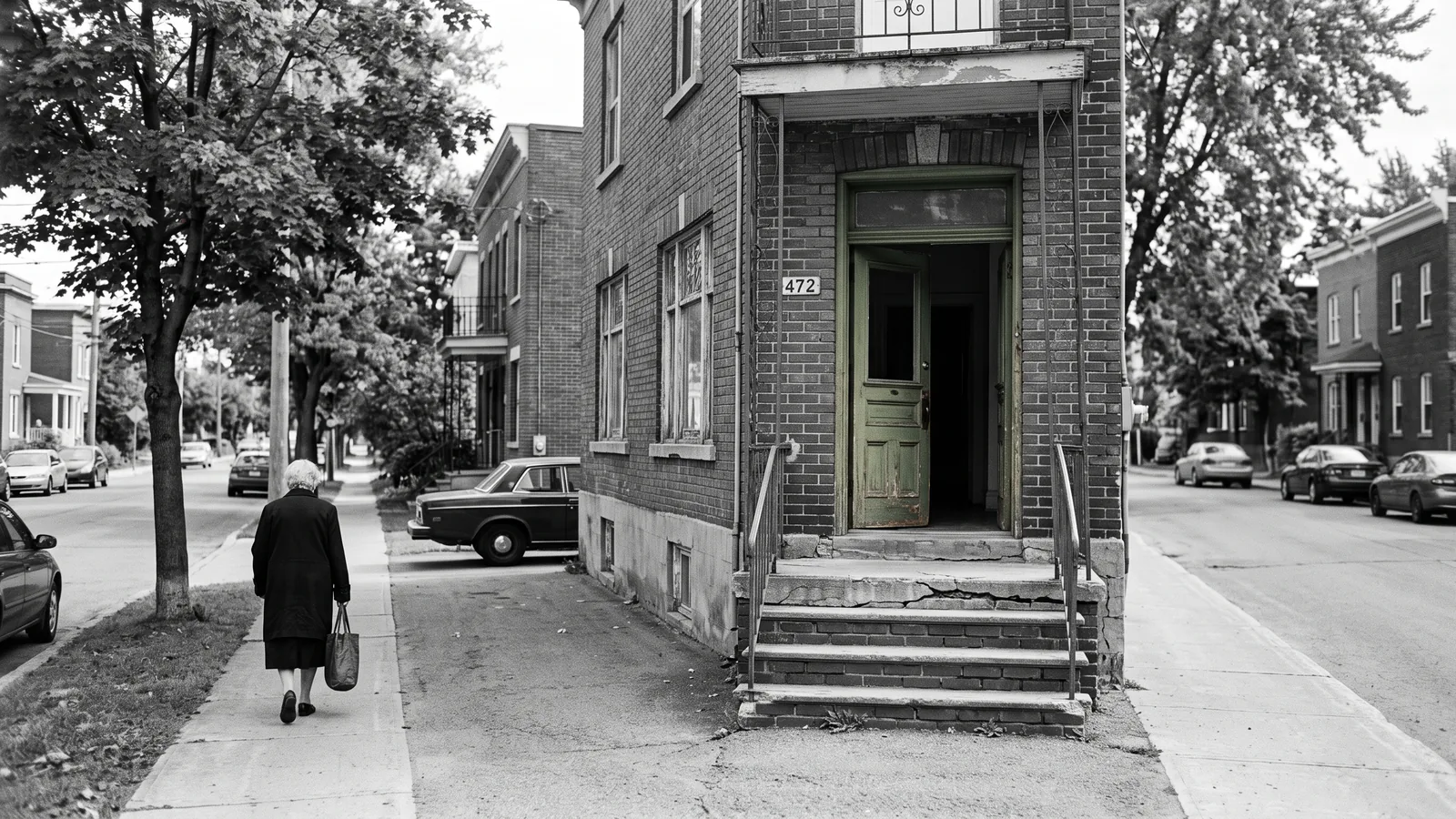
Some cases sum up, all on their own, everything you should not do to recover a dwelling. The one on Malouin Street, in Sherbrooke, is among them. In October 2021, a Radio-Canada report indicated that tenants in that area were denouncing a "disguised eviction": they were allegedly made to sign lease terminations under pressure, by a person presented as not being the actual landlord, and their rehousing reportedly cost them roughly $400 more per month. There was even said to be a repeat offence. We deliberately keep our distance from the facts — these are allegations reported by the media, not a judgment — but the case is a textbook example. It shows how a maneuver that seems "quick" for clearing out a dwelling turns against the person who uses it. And it sheds light, by contrast, on the only healthy way to recover a dwelling frozen below market: the voluntary agreement. This content is provided for informational purposes and does not constitute legal advice.
In this article
The facts: what made headlines on Malouin Street
Let's calmly go back over what the report says, without adding anything to it. In Sherbrooke, on Malouin Street, tenants made their dissatisfaction publicly heard. According to them, they were not evicted through the official door — that of the Tribunal administratif du logement (TAL), Quebec's rental board, which settles disputes between landlords and tenants — but were instead led to sign documents ending their lease. Hence the expression they used: a "disguised eviction." The word is strong, and it is telling: it refers to an eviction that dares not speak its name, obtained by pushing the tenant to "consent" to their own departure.
Three elements stand out from the account, and each carries its own legal weight. First, the pressure: the tenants state that the signatures were not given willingly, but wrung out of them in a context that left them little sense of having a choice. Next, the identity of the person involved: the individual who allegedly had these terminations signed was said not to be the actual owner of the building — a detail that is far from trivial, as we'll come back to. Finally, the cost to the tenants: rehousing reportedly cost them roughly $400 more per month, a gap that, over a year, already amounts to several thousand dollars out of their pockets.
One last element recurs in the report: there was allegedly a repeat offence. What is reportedly at issue is not an isolated incident, but a repeated pattern of conduct. It is often this point that tips a matter from a minor news item into a headline: when the same pattern recurs, it stops looking like a slip and starts to look like a method. Once again, let's stress: these are denunciations relayed by a media outlet, "according to the report," and not facts established by a tribunal. Our aim is not to name a guilty party, but to understand why such a way of doing things is both illegal in spirit and losing in practice.
Key takeaway
A "disguised eviction" is not a term in the Civil Code, but a reality the law knows well: obtaining a tenant's departure by bypassing the TAL, through pressure and a "consented" signature that isn't really consented. On Malouin Street, three ingredients were present according to the report: pressure, a person said not to be the owner, and an added cost of roughly $400 per month for the tenants.
Why it was done wrong: what the law says
To understand why this type of maneuver is problematic, you have to start from a principle that structures all of Quebec's rental law: the right to remain in the dwelling. Under article 1936 of the Civil Code of Quebec, every tenant has a personal right to remain in their dwelling: as long as they meet their obligations, they have the right to stay, and the lease renews. This right is of public order: it cannot be departed from by a clause or an arrangement unfavourable to the tenant. It is the foundation. Anything meant to bypass this right without going through the rare exceptions provided for — good-faith repossession, tightly framed eviction for major work, termination by the tribunal for fault — is built on slippery ground.
Consent must be free: the question of the defect
One might object: "but the tenants signed!" That is precisely where the shoe pinches. A signature is worth something only if the consent behind it is free and informed. The Civil Code considers that consent can be defective — and thus the agreement voidable — when it was obtained through fear, duress, or misleading tactics. If, as the Malouin Street tenants claim, the terminations were signed "under pressure," the very validity of these documents becomes challengeable. In other words, having someone sign a document locks in nothing: if the signature was extracted, the tenant can seek its annulment before the TAL. Pressure, meant to solve the problem quickly, in reality creates a defect that undermines the whole structure.
Add to this a protective principle: an agreement that departs from the tenant's public-order rights can be declared without effect. A tenant cannot validly "waive" protections that the law grants them precisely to rebalance an often unequal balance of power. That is why a termination obtained hastily, in a climate of coercion, is far from the shield imagined by the person who has it signed.
A person said not to be the owner
Here is the element that, in the Malouin Street account, makes the picture significantly worse. The lease binds two parties: the tenant and the landlord. The rights and obligations that flow from it — including that of agreeing to end a lease — belong to the owner or to a representative the owner has duly mandated. A person who is neither the owner nor holds a clear mandate has no power to end the lease in the actual landlord's place. If terminations were signed with someone who was said not to be the owner, the process then combines two weaknesses: consent that is possibly defective and a party who possibly had no standing to act. For a tenant, the wise reflex is simple: check the registry to see who the actual owner is, and sign nothing before doing so.
When pressure becomes harassment
There is a line the law draws clearly, and that this kind of maneuver tends to cross: that of harassment. Article 1902 of the Civil Code is explicit: the landlord — or any other person — may not harass a tenant in a way that restricts their right to peaceful enjoyment of the premises or that induces them to leave the dwelling. The wording is broad: it does not require dramatic acts. Multiplying demands to sign, ratcheting up the pressure, drip-feeding false information about the tenant's rights, implying they have "no choice": the accumulation of these acts, when its aim is to wear someone down, corresponds exactly to what the law seeks to prevent. A landlord who believes they are "negotiating firmly" can, without even realizing it, build a harassment case against themselves. We detail this mechanism in our guide on tenant harassment in Quebec.
The link with bad faith
Finally, this type of case belongs to the broad family of bad faith schemes. Whether the maneuver takes the form of a fake repossession, a disguised "renoviction," or an extorted termination, the logic is the same: dressing up as a legitimate process what is merely a means of clearing out a dwelling to re-rent it more dearly. Quebec law treats these situations severely, precisely because they divert mechanisms designed for other purposes. To go further, see our analyses on bad-faith repossession and on illegal renoviction in Quebec.

The consequences: when the shortcut costs dearly
Here is the part too many landlords discover only after the fact. A "disguised eviction" exposes you not to a single risk, but to a cascade of consequences that can pile up and, together, far exceed the hoped-for gain. Let's lay them out, without putting forward precise amounts: they depend on each case and the rules in force.
The annulment of the termination
The first consequence is the most direct: if the tribunal concludes that the signature was obtained through pressure, fear, or with a person lacking standing, the termination can simply be set aside. The lease is then deemed never to have ended. The "gain" the landlord thought they had secured — a vacated dwelling — evaporates, and they find themselves back to square one, but with a damaged case and a tenant now informed of their rights and on their guard.
Damages and punitive damages
The wronged tenant can claim damages for the harm suffered. In the Malouin Street case, one immediately thinks of the rent gap: if a tenant now bears roughly $400 more per month, that added cost is concrete, quantifiable harm. To this can be added moving expenses, troubles and inconveniences. And when bad faith is established, article 1968 of the Civil Code opens the way to punitive damages, whose function is not to compensate the tenant but to sanction the conduct and deter it. Those damages follow no "cost of rent" logic: they punish, and that is precisely why they can hurt.
Time, fees and uncertainty
Even absent any award, the challenge alone has a cost. A proceeding before the TAL means time — often months — fees, and a weighing uncertainty. Throughout that time, the financial objective remains out of reach: the dwelling is neither cleanly recovered nor rentable with peace of mind, since a dispute looms. The shortcut meant to save time in fact loses it, and a great deal.
What you think you're saving vs. what you're risking
The starting idea seems rational: avoid months of negotiation and possible compensation by "settling it" with a signature. But let's weigh the scales. On one side, the hoped-for saving: a few months of rent and the price of an agreement. On the other, the real risk: annulment of the termination, reimbursement of the rent gap borne by the tenant, damages for troubles, punitive damages in cases of bad faith, fees, months of proceedings — and, if the matter becomes public as on Malouin Street, a tarnished reputation that cannot be bought back. The shortcut does not save money: it turns a manageable cost into an open-ended risk.
Reputation: the cost you never recover
Finally, there is a cost that appears on no invoice, but is often the highest: reputation. When a matter ends up in the media — like the one on Malouin Street — the name associated with the maneuver circulates, sticks, and resurfaces at the slightest search. A landlord who owns several buildings, who wants to rent out other units, obtain financing, or simply live in their community, then carries a label. The word "repeat offence" in a report is not neutral: it durably installs an image. And unlike damages, which you eventually pay off, a damaged reputation cannot be settled with a cheque.
Key takeaway
The consequences of a "disguised eviction" pile up: annulment of the termination, damages (including the rent gap borne by the tenant), punitive damages if bad faith (art. 1968 C.c.Q.), time and fees, and reputational harm that, for its part, cannot be reimbursed. The hoped-for gain is modest and uncertain; the risk, by contrast, is broad and lasting.
What should have been done: the legal path
Let's now ask the question that really matters to a landlord: was there a way to reach the same objective — recovering one or more dwellings — without risking any of that? Yes. And it has a name: the voluntary agreement. Where a "disguised eviction" forces a consent that doesn't exist, the voluntary agreement builds genuine consent, because it makes leaving advantageous for the tenant.
Cash for keys: a negotiated departure, not an imposed one
The principle of cash for keys is as simple as it is legally sound: the landlord offers the tenant to end the lease by mutual agreement, on an agreed date, in exchange for compensation. The tenant is never pushed out: they are presented with an offer, which they are perfectly free to accept or refuse. If they accept, it's because it works for them — enough to cover their move, absorb a possible rent gap, or simply turn the page under good conditions. Both parties sign a clear agreement, and the matter is closed. No reason to prove, no burden of good faith to demonstrate, no possible challenge, since everyone agrees.
The difference with Malouin Street is total, and it comes down to one word: consent. In a well-run cash for keys, consent is genuine, free and informed — exactly what was missing, according to the tenants, in the denounced signatures. It is this difference that shifts the same end goal (freeing up a dwelling) from the side of maximum risk to the side of zero risk.
Cash for raise: when the tenant stays, but at the right price
There is a useful variant for cases where the landlord doesn't need the dwelling to be vacated, but simply wants to bring it back to its value: the cash for raise. Here, the tenant is not asked to leave; you agree with them on an accepted rent adjustment, often in exchange for consideration. The tenant stays put, the rent catches up to the market, and no one is shown the door. It's another illustration of the same principle: you move forward by agreement, not by coercion.
Recovering dormant value, cleanly
Behind these tools lies an economic reality that Malouin Street illustrates in its own way: a dwelling rented far below market represents considerable dormant value. The problem is not going after it — that is legitimate — but the method. Restoring a dwelling to its fair value, once cleanly recovered by agreement, frequently creates value counted in the tens of thousands of dollars on the asset. We explain all of this on our rent optimization page. The lesson from Sherbrooke is therefore not "give up optimizing": it's "do it through the right door."
Why go through pros
One legitimate objection remains: if the voluntary agreement is so simple, why not carry it out yourself? Because the line between a healthy negotiation and illegal pressure is thin, and a landlord in a hurry, alone facing their tenant, often crosses it without even noticing. That is exactly what seems to have happened on Malouin Street: the intention to "settle it quickly" slid, step by step, toward what the tenants experienced as coercion.
The vocabulary, the framing, the paper trail
A well-run process plays out in the details. The vocabulary used — proposing rather than demanding, presenting an offer rather than requiring a signature. The framing — leaving the tenant the time and freedom to say no. The paper trail — a written agreement that shows in black and white that the departure was consented to, with consideration, without threat. That is precisely the work a specialized firm does: structuring the process so it stays voluntary, documented, and TAL-compliant, from first contact to signature. Where the lone landlord improvises, the professional applies a proven method that protects both parties. We develop this point in our article why call on a pro to recover a dwelling.
The pay-only-for-results model: the risk on our side
At Opti Loyer, the job is precisely to recover and optimize dwellings through voluntary agreements, in compliance with the Tribunal administratif du logement. Two things set this approach apart from a hastily done negotiation. First, the initial audit is free: we look together at the dormant value of your building, with no commitment. Second, and above all, the model is pay only for results: you pay only if the agreement closes and you get the result. The financial risk of the process does not rest on you — it rests on us. And because everything is done by agreement, there is nothing to "hide," nothing that could one day turn against you in a news report.

You only have one name in life
Cases like the one on Malouin Street all share a common denominator: a landlord who wanted to move too fast, alone, bypassing the rules rather than using them. The result is almost never the one hoped for. Where speed was sought, months of proceedings are reaped; where savings were the aim, exposure to damages follows; and where the goal was to quietly "settle a file," a headline is sometimes inherited. All of that for an objective — recovering or revaluing a dwelling — that was perfectly achievable through the right door.
You only have one name in life. Gambling it on a shortcut that can cost tens of thousands of dollars and a reputation, when a legal, clean and risk-free path leads to exactly the same goal, makes no sense. The voluntary agreement — cash for keys, cash for raise — is not a "soft" version of recovering a dwelling: it's the smart version, the one that protects your asset and your name. At Opti Loyer, that's what we do: legally, in compliance with the TAL, pay only for results. The risk is on our side. Yours: describe your situation and see what it's worth.
This article is provided for informational purposes and does not constitute legal advice. The facts reported come from a media report and are presented as allegations not adjudicated by a tribunal. The rules and interpretation of the Civil Code of Quebec and the TAL evolve; always validate the terms in force or consult a legal advisor before acting.