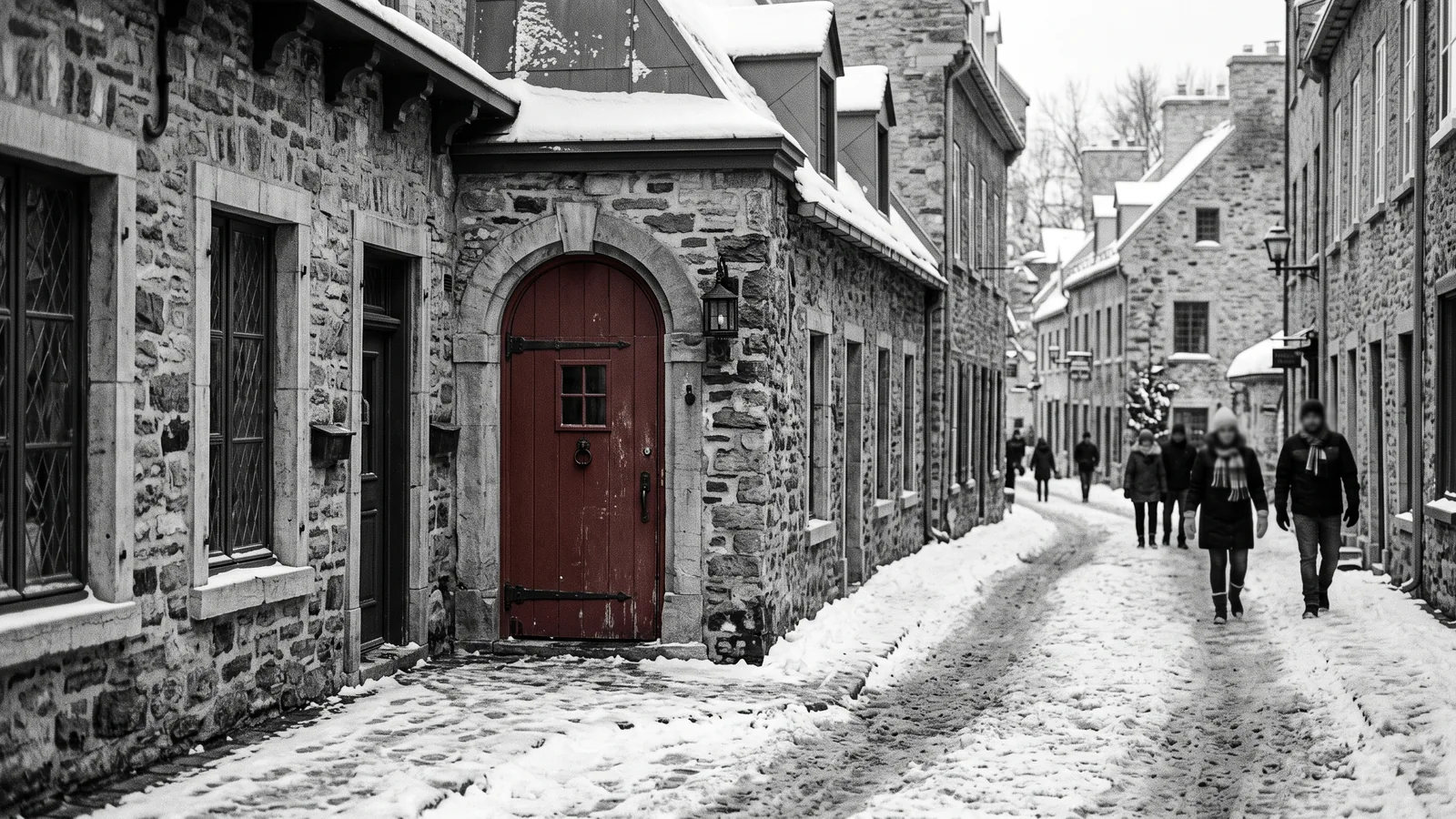
In April 2026, a decision by the City of Québec made headlines : the freeze on new tourist accommodations in Old Quebec. The municipal message is crystal clear — too many residential dwellings are being turned into rentals for travellers, and the area's rental stock is suffering for it. According to Radio-Canada's report, the City wants to curb this conversion and protect the dwellings that remain. This case is a textbook example of municipal regulation of Airbnb pressure — and a perfect occasion to recall what a landlord can, and cannot, do when they dream of pulling a dwelling off the rental market. The answer fits in a single sentence : there is a legal path, and there is a shortcut that costs tens of thousands of dollars.
In this article
The facts : what Québec decided
Old Quebec is one of the most visited neighbourhoods in North America. It is also a place where people live : behind the walls and cobblestone streets, there are residents, leases, households looking for a year-round roof. It is this dual vocation — living and welcoming tourists — that lies at the heart of the April 2026 decision. The City of Québec chose to freeze new tourist accommodations in Old Quebec, in other words to prevent the emergence of new short-term rental units in the area.
The goal, as reported, is twofold : to curb the conversion of residential dwellings into tourist rentals and to preserve the rental stock for the people who want to live there. The municipal logic is straightforward. When a dwelling shifts to tourist accommodation, it disappears from the supply meant for residents. Multiply that phenomenon across an entire neighbourhood, and you get fewer dwellings, upward pressure on rents, and a residential fabric that crumbles in favour of a transient economy. The freeze is an urban-planning response to this imbalance : you turn off the tap of new conversions.
We have to be precise about what is known and what is not. The report clearly establishes that the measure targets new tourist accommodations. The exact fate of units already in operation, any grandfathered rights, exceptions and precise terms fall under the regulatory text itself ; we do not detail them here so as not to attribute to the decision contours it may not have. A landlord directly affected should verify their exact situation with the City. What interests us is the direction of the signal — and it could not be clearer.
Key takeaway
The City of Québec is freezing new tourist accommodations in Old Quebec to stop the conversion of residential dwellings and protect the rental stock. It is an example of direct municipal regulation of Airbnb pressure on an inhabited area.
Airbnb pressure on the rental stock
To understand why a city ends up freezing permits, you have to look at the economics of the thing from the landlord's point of view. In a tourist neighbourhood, a dwelling rented by the night can, on paper, bring in more than a classic residential lease. The temptation is real : why collect a "frozen" monthly rent when the same unit could generate far higher short-term income in peak season? It is exactly this calculation, repeated by hundreds of landlords, that empties a neighbourhood of its housing.
The problem is that what is rational for a landlord taken in isolation becomes harmful at the scale of the neighbourhood. Every unit that leaves the rental market is one fewer household able to live in Old Quebec. Through repeated subtractions, the residential supply grows scarce, prices rise, and the neighbourhood turns into a showcase rather than a living environment. Municipalities cannot remain bystanders : housing is a major political issue, and regulating tourist accommodation has become one of their main levers.
The Old Quebec freeze is part of a broader trend in Quebec, where rules on short-term rental keep multiplying : zoning restricting tourist uses to certain areas, mandatory provincial registration, requirements to display the establishment number, restrictions on principal residence versus secondary residence, and toughened penalties against illegal operators. The underlying message is consistent everywhere : tourist accommodation is no longer a use you can improvise in just any dwelling.
For a landlord, the first lesson is therefore regulatory : before even thinking about "freeing up" a dwelling, you have to check whether the intended use is even permitted. In the 2026 version of Old Quebec, the answer for a new tourist unit is now : no. Building a project on a prohibited use is building on sand — and it is the first floor of a stack of mistakes that can be very costly.

Why the Airbnb shortcut is illegal or badly done
Here is the heart of the matter. Let's set aside the municipal question for a moment and suppose that a tourist use is permitted. There remains an obstacle that too many landlords underestimate : the dwelling they covet is occupied by a tenant in good standing. And here, Quebec law is unambiguous.
The right to remain in the dwelling : the starting wall
The Quebec tenant benefits from the right to remain in the dwelling, enshrined in article 1936 of the Civil Code of Québec (C.c.Q., Quebec's civil code). As long as they meet their obligations — paying rent, not causing disturbances — they have the right to stay, and their lease renews. The mere fact that another use of the dwelling would be more profitable is not a valid reason to end the lease. Wanting to turn an occupied dwelling into a tourist rental therefore runs straight into this fundamental right from the outset. The landlord cannot unilaterally decide that the tenant must leave because Airbnb would bring in more.
The only ways to end a lease against the tenant's will are limited and regulated : a good-faith repossession (to house the landlord or an eligible relative), an eviction for major work or an authorized change of use, or a termination for fault (non-payment, disturbances). None of these grounds says "I want to do tourism." Converting a dwelling into an Airbnb is neither a repossession to live in it, nor a fault of the tenant. There simply is no legal ground of "I'm recovering it to rent to tourists."
The temptation of the pretext : fictitious repossession and disguised eviction
Lacking an honest ground, some landlords give in to the temptation of the pretext. They invoke a repossession of the dwelling claiming they want to house a relative, when the real plan is to turn it into a short-term rental. This is a bad-faith repossession : the law may presume good faith at the outset, but as soon as the announced beneficiary never moves in and the dwelling ends up on a tourist platform, the deception comes to light. The evicted tenant can turn to the Administrative Housing Tribunal (TAL), even after leaving.
Another variant : the disguised eviction. False major work is announced, a rent increase is inflated to make staying impossible, or hassles are piled on until the tenant cracks and leaves "on their own." This is exactly the kind of manoeuvre that the law and case law seek to punish. Our guide on illegal renoviction in Quebec details why these schemes almost always backfire on those who use them.
Harassment : article 1902 C.c.Q.
When pressure becomes the method, you enter the territory of harassment. Article 1902 of the Civil Code of Québec prohibits a landlord from harassing a tenant in a way that restricts their peaceful enjoyment of the premises or that pushes them to leave the dwelling. Repeated visits, intimidating notices, thinly veiled threats, cutting off or degrading services : these acts, when aimed at "freeing up" a dwelling to make it more profitable, can constitute harassment within the meaning of the law. The Administrative Housing Tribunal (TAL) takes these situations very seriously and can award the tenant damages, including punitive damages intended to discourage this behaviour.
The common thread running through all these avenues is the same : there is no "clean" version of forced conversion. As soon as you try to circumvent the tenant's rights — through a false ground, invented work or pressure — you commit a fault that exposes you to recourse. The only question becomes : at what price will the fault be discovered? And in an age of reports on renovictions and increasingly well-informed tenants, it is discovered more and more.
The consequences : fines, damages, reputation
Let's now add up the bill for the landlord who tried to force a tourist conversion in an area like Old Quebec. It reads across three columns, and each one hurts.
The regulatory front : fines and orders
First, the municipal and provincial wall. Operating a tourist accommodation without authorization — without registration, in violation of zoning, or in a frozen area like Old Quebec — exposes you to fines and orders to cease the activity. In other words, even if the landlord managed to empty the dwelling, they could find themselves unable to legally operate it as a tourist rental. The freeze turns the project into a dead end : you've created a vacant dwelling, evicted a household, and the coveted use remains prohibited. It's the worst of both worlds.
The rental front : damages and punitive damages
Next, the Administrative Housing Tribunal. A tenant evicted through a fictitious repossession, a disguised eviction or harassment can claim damages for the harm suffered : moving costs, the rent difference in a new, often more expensive dwelling, trouble and inconvenience. To this can be added punitive damages, whose very purpose is to punish and deter deliberate manoeuvres. The amounts are not symbolic : recent case law shows a trend toward severity, precisely because the courts want to send a signal. The shortcut that was supposed to pay off ends up emptying your pockets. For a sense of the orders of magnitude, see our analysis of penalties and fines for renoviction in Quebec.
The reputational front : the headline
Finally — and this is often the most underestimated — there is reputation. Stories of abusive evictions and dwellings converted into Airbnbs have become a favourite subject of the Quebec media. A landlord caught in the act does not merely risk a bill : they risk seeing their name, or their company's, publicly associated with a practice that public opinion condemns. In a market where you do business with tenants, partners and financial institutions, that label sticks. You only have one name in life ; gambling it on a scheme to save a few months is a very bad bet.
Key takeaway
Circumvention is paid for on three fronts at once : fines and orders on the regulatory side, damages and punitive damages on the TAL side, and lasting harm to reputation on the public side. The hoped-for "gain" from a forced conversion is almost always wiped out — and well beyond — by these three columns combined.
What should have been done : the voluntary agreement
Let's move to the constructive part. Suppose an honest landlord who, in an area where the use would be permitted, wishes to recover an occupied dwelling to change its use or simply to bring it back to its fair value. If they have no legal ground for repossession, one perfectly clean path remains : the voluntary agreement.
Cash for keys : the tool made for this
The principle of cash for keys is simple : rather than inventing a ground or applying pressure, you propose an agreement to the tenant. They agree to end the lease and leave on an agreed date ; in exchange, they receive financial compensation. Everything is recorded in a clear written agreement, freely signed by both parties. It is a mutual lease termination, nothing more.
Why does this work where the shortcut fails? Because the foundation changes entirely. There is no ground to justify, since no one is imposing anything : the tenant is not evicted, they consent. There is no possible contestation before the TAL, since there is no decision to contest : both parties agree. And there is no risk of bad faith, since no right is being diverted — you are honestly negotiating an end of lease. The tenant only accepts if they come out ahead, and that is exactly as it should be : a good agreement is one where everyone wins.
The essential distinction : to occupy vs to recover
Remember this simple rule, which avoids the vast majority of mistakes. Repossession of a dwelling serves to occupy the dwelling — yourself or an eligible relative. The voluntary agreement serves to recover the dwelling amicably, to re-rent it, renovate it, sell it or optimize its return. A tourist project never falls into the first category : you don't "live in it," you operate it. On the rental side, then, it is a voluntary-agreement matter — never a repossession. Confusing the two is exactly the mistake that leads to fictitious repossessions and convictions.
And for the landlord who simply wants to bring a below-market rent up to its fair value without even emptying the dwelling, there is a third, even gentler path : cash for raise, where you reach an agreement with the tenant on an adjustment rather than a departure. The guiding idea remains the same in every case : you move forward by consent, never by circumvention.

Why to go through professionals
Let's pick up the thread of the Old Quebec case to draw the real lesson. The municipal freeze is not just one more constraint : it is the symptom of an environment where improvising has become dangerous. Between zoning, provincial registration, the right to remain in the dwelling, repossession rules, harassment recourse and media vigilance, the landlord who acts alone multiplies the chances of a misstep. And every misstep, as we've seen, comes to thousands of dollars and reputation.
This is precisely where a specialized firm changes the game. At Opti Loyer, our business is to recover and optimize dwellings through voluntary agreements, in compliance with the TAL and the rules in force. In practice, that means : we first check what the regulations actually allow for your building ; we identify the clean path — cash for keys, cash for raise, or simply optimization — suited to your situation ; and we conduct the negotiation with the tenant in a professional, transparent and documented way. No false ground, no pressure, no grey zone.
The model is pay only for results. The initial audit is free : we look together at your building's dormant value, with no commitment. And you only pay if the agreement is reached and you obtain a concrete result. In other words, the financial risk of the process does not rest on you — it rests on us. It's the exact opposite of the shortcut : instead of gambling your name and your savings on a scheme, you entrust the file to people whose interest is aligned with yours.
These cases of failed evictions and blocked conversions all prove the same thing : a shortcut can cost tens of thousands of dollars, on top of your reputation. You only have one name in life. Protecting it doesn't mean giving up on optimizing your building ; it means optimizing legally, by the right path, with the right people. That is exactly what we do.
This content is provided for informational purposes and does not constitute legal advice. Municipal rules, tourist-accommodation rules and TAL rules evolve and carry nuances : verify the terms in force or consult a legal advisor before acting.