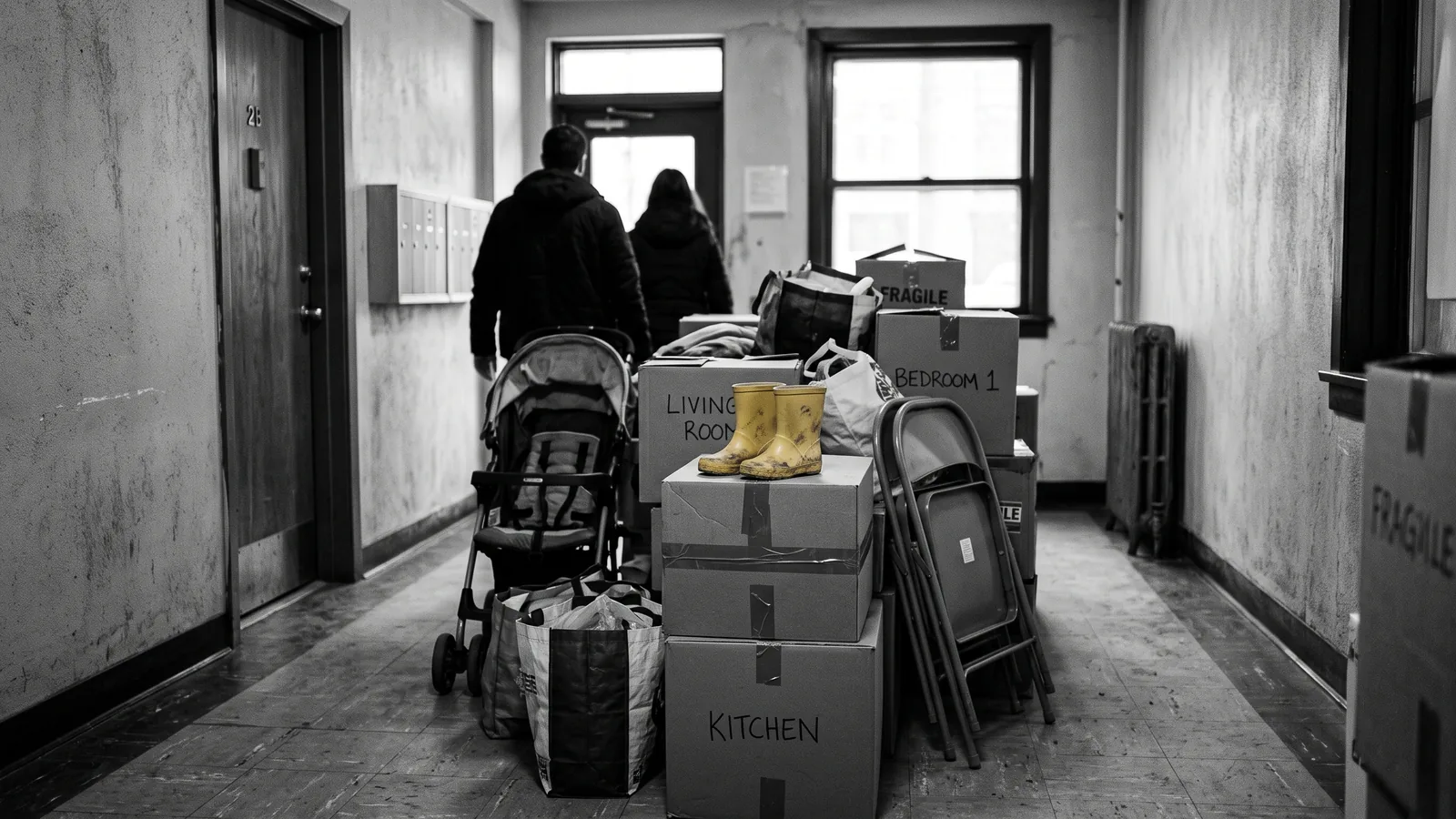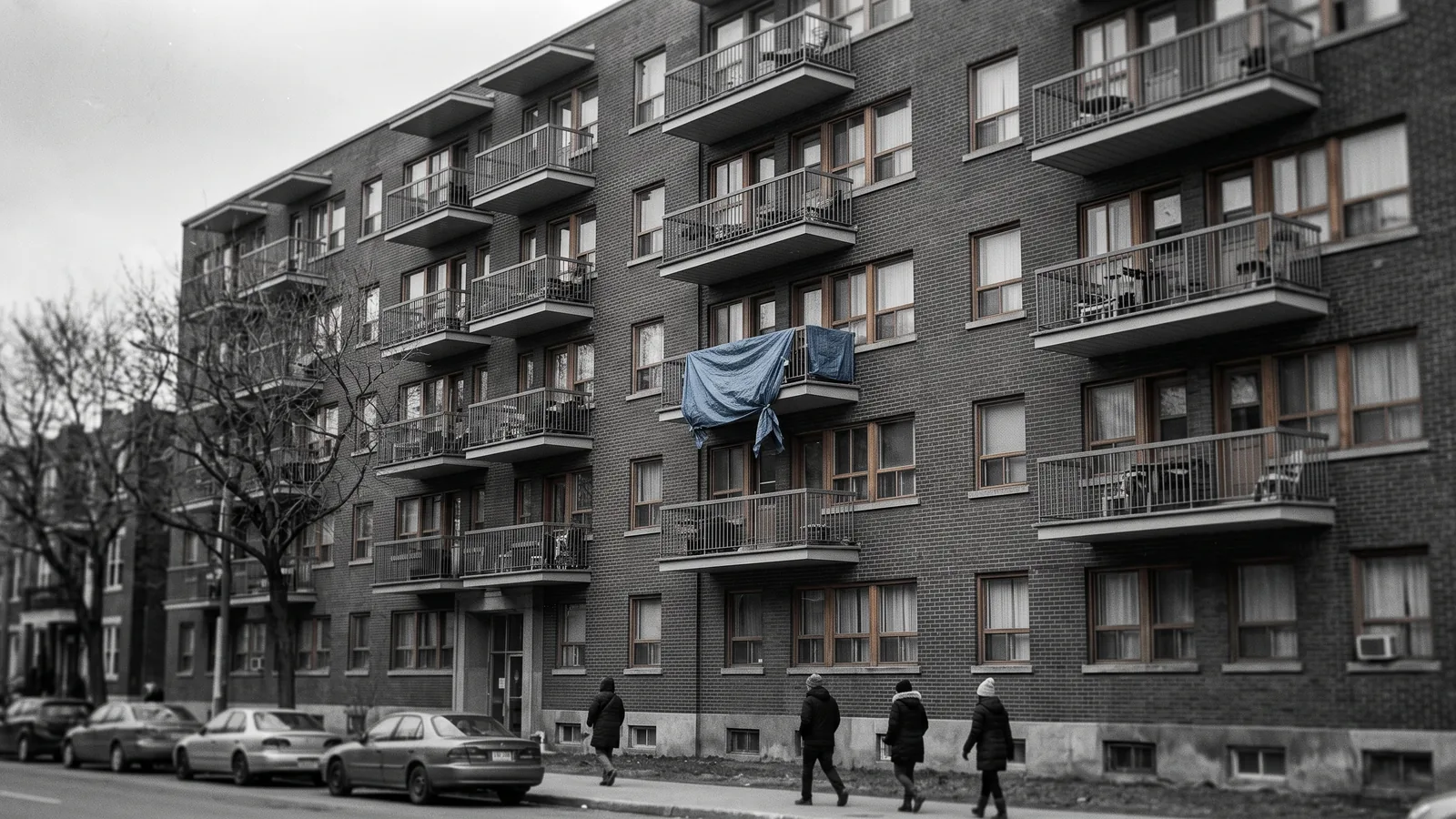
Some cases make headlines because they affect one person; the one on Bourret Avenue, in Côte-des-Neiges, affected dozens at once. According to a CBC report, up to around fifty families reportedly received notices threatening them with eviction, backed by grounds presented as groundless — including, according to the report, unpaid rent that simply did not exist. Management of the buildings was associated with Cogir at the time. None of this has, at this stage, been decided by a tribunal: these are allegations reported by the media, and we treat them as such. But the case is a valuable teaching example, because it highlights, at full scale, the red line too many landlords cross without measuring what they risk — and the perfectly lawful path they could have taken instead.
In this article
The facts: what made the headlines
Let us take the case as it was reported, adding nothing to it. On Bourret Avenue, in the Côte-des-Neiges–Notre-Dame-de-Grâce borough, several rental buildings house families who have lived there for years, sometimes for a long time. According to the report, up to fifty of these households reportedly received, over a short period, notices threatening them with the loss of their home. This is not an isolated case of a dispute between a landlord and a tenant: it is, if the report is to be believed, a wave of notices affecting an entire area.
The most troubling point concerns the grounds invoked. Again according to the report, some of these notices were allegedly based on reasons deemed groundless — and, in several cases, on alleged rent arrears that reportedly did not exist. In other words, tenants were reportedly accused of not having paid rent they had in fact settled. Management of the buildings was tied to Cogir at the time of the reported events. Tenants and advocacy groups reacted publicly, which is why the story emerged from the shadows of the Tribunal administratif du logement's hallways to land in the media.
An essential nuance: allegations, not a ruling
Let us stress this, because it matters. At the time of writing, these are allegations reported by a news story, not the conclusions of a tribunal. So we write “according to the report,” “reportedly received,” “allegedly based on”: each case has its own story, and only the TAL can establish, case by case, what actually happened and who is right. Our purpose is not to name a culprit, but to explain a principle: if the alleged facts were confirmed, how would such an approach be illegal, and what could — should — have been done differently?
Why a “wave” changes everything
An eviction happens; it is sometimes legitimate. What tips a case from routine to headline is scale and motive. When some fifty families in a single area receive notices in a short time, and those notices are allegedly based on questionable reasons, the picture that emerges is no longer that of a one-off dispute: it is that of a strategy. Yet in Quebec, you do not “clean house” in a building to put it back on the market with questionable notices. A tenant in good standing has a powerful right: the right to stay in their home.
Key takeaway
According to the report, up to 50 families on Bourret Avenue reportedly received eviction notices based on grounds deemed groundless, including fake rent arrears. These are allegations that have not been decided; but if they were confirmed, they would describe exactly what the law prohibits.
Why it is illegal (if the facts hold up)
To understand why such an approach is problematic, you have to start from a founding principle of Quebec rental law: the right to remain in the dwelling. Article 1936 of the Civil Code of Québec states it unambiguously: every tenant has a personal right to remain in the dwelling. In concrete terms, a tenant who pays their rent and meets their obligations cannot be forced to leave: they can stay, lease after lease, for as long as they wish, except in the specific cases provided by law (repossession in good faith, eviction for major work, termination for a proven fault). This right is the backbone of everything else.
A fake arrear does not create a ground
Non-payment of rent is indeed a recognized ground for termination — but on one condition: that it be real and proven. A landlord who wants to terminate a lease for non-payment must apply to the TAL and demonstrate, with supporting evidence, that the rent was not paid. It is not the tenant who must prove they paid; it is up to the applicant to establish their claim. So claiming that a tenant owes arrears that do not exist — which the report raises — carries no legal weight whatsoever. A tenant who has their receipts or bank statements need only produce them. The false ground collapses at the first serious examination.
You have to see clearly what this means. Fabricating a debt to push someone toward the exit is not a “poorly assembled” eviction: it is an approach that, in fact, seeks to bypass the right to remain in the dwelling through a pretext. That is precisely what the law calls bad faith.
Harassment within the meaning of article 1902
The Civil Code does not stop at the right to remain in the dwelling. Its article 1902 expressly prohibits the landlord — or any other person — from harassing a tenant in a way that restricts their right to peaceful enjoyment of the premises or drives them to leave the dwelling. Harassment, here, is not limited to head-on threats: it includes repeated and unjustified notices, pressure, intimidation, and yes, inventing debts or grounds. What matters is not the form of the act, but its purpose: pushing the tenant out through channels other than the legal ones.
Sending a household a notice based on a fictitious arrear ticks, on paper, several of the harassment boxes: it is a manoeuvre meant to instill fear of losing the home in order to provoke a departure. And when the same pattern repeats across dozens of dwellings, the argument of an isolated administrative error becomes hard to sustain. We detail this mechanism in our guide to tenant harassment in Quebec: the law does not require malicious intent proven beyond all doubt; it looks at the effect of the acts.
Disguised eviction, renoviction: the same logic
The Bourret Avenue case belongs to a family of practices Quebec knows well: those where a landlord seeks to recover below-market dwellings by pushing tenants out under a pretext. The pretext may be major work there is no real intention of carrying out (the notorious illegal renoviction), a repossession for a relative who will never move in, or — as here, according to the report — a debt that does not exist. The staging changes; the mechanism is identical: dressing up as a legitimate ground what is, at bottom, merely a desire to empty the dwelling in order to re-let it for more. The law calls this a disguised eviction, and it penalizes it.

The consequences: damages, punitive damages, reputation
Let us suppose, for the sake of the demonstration, that an eviction of this kind were established and brought before the TAL. What does the landlord — or the manager — really risk? The answer has two dimensions: the strictly legal, quantifiable one; and the reputational one, often far more costly.
Damages and punitive damages
On the legal side, the Civil Code gives the tenant a formidable lever. Article 1968 provides that a tenant evicted or repossessed in bad faith can claim damages for the harm they suffer — moving costs, the rent difference in a new, often pricier dwelling, trouble and inconvenience — and that the tribunal may add punitive damages on top. Punitive damages are not meant to compensate a loss: they are meant to punish and deter. It is precisely because the act is intentional and abusive that the tribunal may decide to hit the wallet beyond the mere harm.
We will put forward no figure here for this case, since nothing has been decided. But recent Quebec case law shows a clear trend: the tribunals are taking these cases increasingly seriously, and the amounts awarded have climbed. We explain this in detail in our analyses of the cost of a renoviction and of why damages for illegal repossession are exploding. The era when an abusive eviction ended with a symbolic slap on the wrist is over.
The silent multiplier: scale
There is an aggravating factor specific to a case like Bourret's: numbers. One conviction is one file; fifty families are potentially multiple claims, each with its own damages and, where applicable, its own punitive damages. A shortcut meant to save time on an entire building can turn into a stack of convictions. The calculation that seemed advantageous at the outset — “I recover all the units at once” — becomes the worst possible scenario: you multiply not the gains, but the risks.
Reputation: the cost no ruling reimburses
And then there is what money cannot buy back. The day your name, or your company's, appears in a report headlined “groundless evictions,” something breaks that no cheque repairs. Future tenants look you up online before signing; so do partners, lenders, municipalities. A headline of this kind stays indexed, cited, shared: it follows you. In a market where a landlord's reputation has become an asset in its own right, publicly exposing yourself as the one who invents debts to evict families means mortgaging far more than one unit's rent. These cases are talked about more and more; we in fact review them regularly in our feature on renovictions in the Quebec media.
What should have been done: the legal path
Here is the heart of the lesson, and the good news for every honest landlord: in this situation, there existed a perfectly lawful path to reach the same economic result — recovering below-market dwellings — without inventing anything and without risking a single dollar in damages. That path is the voluntary agreement.
Cash for keys: recover by agreement, not by pretext
The principle is disarmingly simple. Rather than invoking a ground — true or false — you offer the tenant an agreement: they agree to end their lease and leave the dwelling on an agreed date, in exchange for compensation. This is what is called cash for keys. Nothing in the law prohibits a landlord and a tenant from agreeing together to terminate the lease: it is a mutual agreement, like thousands that exist each year. The essential difference from the Bourret case? The tenant's free and informed consent. No one is deceived, no one is threatened; the tenant agrees because it works in their favour.
And because everyone agrees, there is no ground to prove, no burden of proof, no possible dispute, and no imaginable bad faith: you cannot be in bad faith in an agreement the other party signs freely. The file closes cleanly, with a written agreement that protects both parties. It is the exact opposite of the road that leads to headlines.
Cash for raise: when the tenant does not want to leave
Sometimes the goal is not even to recover the dwelling, but to correct a rent that has become absurd relative to the market without forcing anyone to move. Here too, there is a path of agreement: cash for raise, where you negotiate, by mutual agreement, a rent adjustment acceptable to both parties, often in exchange for improvements or an arrangement. It is gentler, just as lawful, and it lets you keep a good tenant while bringing the rent closer to its fair value. For an entire building like those on Bourret, an agreement-based approach — dwelling by dwelling, amicably — would have produced a lasting result, without a single questionable notice.
Why an agreement always beats a pretext
One might think an agreement costs more than a “free” eviction. That is an accounting illusion. Eviction by pretext is never free: it carries a hidden, latent cost that materializes the day the tenant contests — and they contest more and more. A negotiated compensation is a known, controlled, capped cost; a conviction for bad faith is an unknown, open-ended cost, multiplied by the number of files and weighed down by punitive damages and fees. Between a figure you choose and a figure a judge imposes on you, the rational choice is not hard. To go deeper into the legal mechanics and the profitability of this approach, see our rent optimization service.
Key takeaway
The same economic goal — recovering or revaluing a below-market dwelling — is achieved lawfully through the voluntary agreement: cash for keys to free up, cash for raise to adjust. The tenant's free consent, a written agreement, no ground to invent, no possible dispute. It is faster, safer, and carries no risk of damages.
Why go through professionals
One honest question remains: if the legal path is so simple, why do so many landlords still take the shortcut? Because, on their own, they do not know exactly where the boundary lies, how much to offer, how to draft the agreement so it holds, or how to approach a tenant without the process turning into pressure. And it is by improvising, under the stress of a frozen rent and a building to make profitable, that they slide toward the pretext. That is exactly where a professional changes everything.
The risk on our side: paid for results
At Opti Loyer, our business is recovering and revaluing dwellings through voluntary agreements, in strict keeping with the Tribunal administratif du logement. We know the boundary down to the millimetre: what is said, what is not said, what is signed, what is documented. We negotiate the agreement on your behalf, without ever resorting to the slightest pressure — because an agreement obtained under pressure is not an agreement, it is a future dispute. And above all, our model is pay only for results: the initial analysis is free, and you pay only if the agreement is reached and you get the result. The financial risk of the process does not rest on you; it rests on us. It is the exact opposite of the solo gamble that leads to convictions.
You only have one name in life
At bottom, the Bourret Avenue case tells one thing: the price of a shortcut. Saving on compensation by inventing a ground means risking tens of thousands of dollars in damages, fees, and time — and, more seriously still, it means risking your name. You only have one name in life, and a single headline is enough to tarnish it for years. The legal method exists, it leads to the same economic result, and it leaves your reputation intact. On reflection, there is no good reason to choose the other road.
If you hold a dwelling stuck far below market and are wondering how to recover or revalue it cleanly, don't set off alone into a grey zone. First get an initial estimate with our value calculator, then request your free analysis: we look together at the dormant value your building holds, and we tell you frankly which agreement path suits your situation. You pay only if it works.
This content is provided for informational purposes and does not constitute legal advice. The facts reported in this article are allegations not decided by a tribunal; they are presented in the conditional. TAL rules and deadlines change — verify the terms in force or consult a legal adviser.