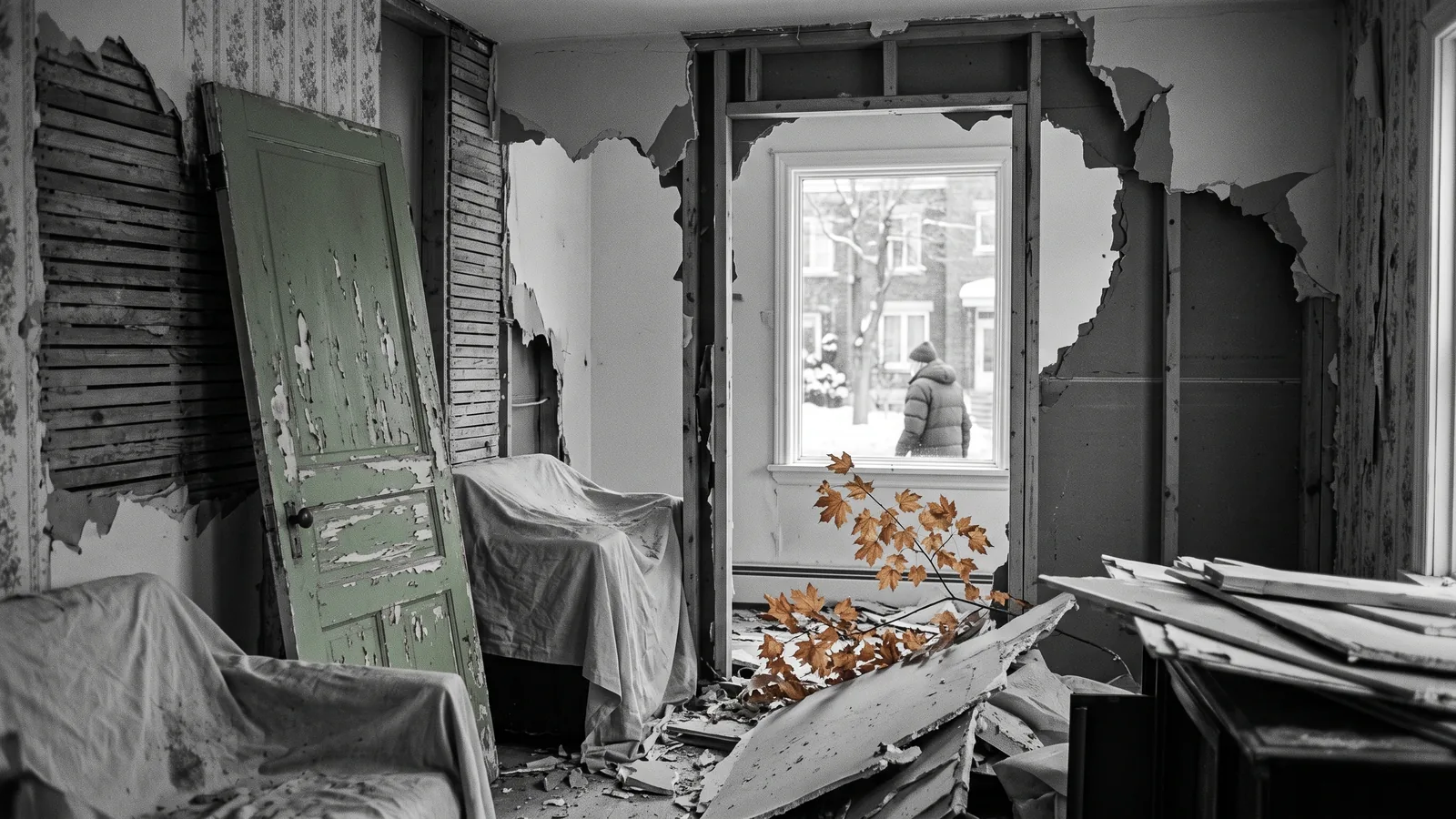
This is the kind of decision that should be pinned above the desk of every landlord in a hurry to "free up" a dwelling. In Fortier v. 9443-5070 Québec inc. (2025 QCTAL 12557), the Administrative Housing Tribunal (Tribunal administratif du logement, or TAL, Quebec's rental board) ordered a landlord to pay $24,000 to his tenant: $20,000 in punitive damages and $4,000 in moral damages. The reason? The landlord had harassed his tenant to force them out, with a view to renovations. In other words, a renoviction carried out not through a procedure, but through pressure. The tribunal restated a rule that too many landlords ignore or choose to ignore: harassing a tenant to evict them is expressly prohibited by article 1902 of the Civil Code of Québec. This case is not an anomaly; it is the dollar-and-cents illustration of a principle. And it comes at a time when renovictions regularly make headlines in Quebec.
In this article
The facts: what the Fortier case tells us
Let us start with what the decision establishes, without adding anything to it. In Fortier v. 9443-5070 Québec inc., a landlord — a numbered company, of the kind so many real-estate investors hold — wanted to recover an occupied dwelling in order to carry out renovations. The tenant, for their part, was at home: they occupied the dwelling under a lease and enjoyed, like every tenant in Quebec, the right to remain there.
Rather than taking a route provided by law to achieve his ends, the landlord chose pressure. The Administrative Housing Tribunal concluded that he had harassed the tenant in order to force them to leave. It is this conduct — harassment as an eviction strategy — that lies at the heart of the decision and that led to the order. The tribunal awarded the tenant $20,000 in punitive damages, in the form of two amounts of $10,000, along with $4,000 in moral damages, for a total of $24,000.
One important clarification, in fairness: we do not detail here the exact nature of the acts complained of, because the aim of this article is to explain the legal principle and its consequences, not to reconstruct the file act by act. What matters from the facts is simple and sufficient: a landlord wanted to empty a dwelling to renovate it, he went about it through harassment, and it cost him $24,000. The general concept of renoviction and the reference to this case are, moreover, publicly documented, notably in the encyclopedia entry on renoviction.
Key takeaway
A landlord wanted to recover a dwelling to renovate it. Instead of going through a legal channel, he harassed his tenant to push them out. The TAL imposed $24,000 on him: $20,000 in punitive damages and $4,000 in moral damages. Harassment is not a "calculated risk": it is a fault that has a price.
Why it was illegal: harassment and the right to remain
To understand why the tribunal reacted so firmly, we need to go back to two founding principles of Quebec residential-tenancy law. Together, they explain why the landlord's strategy was doomed from the start.
The right to remain in the dwelling
In Quebec, the tenant enjoys a right to remain in the dwelling (article 1936 of the Civil Code of Québec). In concrete terms, this means that a tenant who meets their obligations — pays the rent, causes no serious disturbance — has the right to stay in their home, lease after lease, without being turned out simply because it is convenient for the landlord. This right is one of the cornerstones of the system; it is what gives tenants real stability. A landlord may depart from it only in specific, regulated cases: for example, a good-faith repossession of the dwelling, or an eviction for major work in compliance with the rules. Outside these exceptions, the dwelling remains the tenant's.
Here is the first reason the landlord's approach could not work: he had, in reality, no guaranteed legal route to empty the dwelling at will. The tenant had committed no fault; there was therefore nothing to "hold against" them that could ground an eviction. The landlord then turned to pressure — and that is where the law stands like a wall.
The prohibition on harassment: article 1902 C.c.Q.
The Civil Code of Québec does not merely recognize the tenant's right to stay: it actively protects the exercise of that right. Article 1902 C.c.Q. prohibits the lessor — or any other person — from using violence, threats, harassment or abusive work to try to prevent a tenant from exercising their right to remain in the dwelling, or to force them to leave.
It is a provision of formidable clarity. It targets precisely the scenario of the Fortier case: a landlord who, unable to obtain a departure through a legal channel, tries to make the situation unpleasant enough that the tenant "chooses" to leave. The law refuses this logic. Whatever the dressing — "I just wanted to renovate," "I thought I was doing the right thing" — as soon as the acts have as their object pushing the tenant toward the door, they fall under the prohibition. Harassment can take many forms: repeated pressure, intimidation, unjustified notices, abusive entries, interruption or degradation of services, work carried out in a disruptive manner. We detail this spectrum in our guide on tenant harassment in Quebec.
Renoviction: the pretext of work whitewashes nothing
The word renoviction — a blend of "renovation" and "eviction" — describes exactly this kind of maneuver: using work, whether real or pretended, to get rid of a tenant, often to re-rent at a higher price afterward. There is indeed a legitimate eviction for major work, but it is regulated: it requires a genuine project of subdivision, enlargement or change of use, a compliant notice, compliance with deadlines and compensation for the tenant. It remains demanding and fully contestable before the TAL.
What the Fortier case illustrates is that invoking the work does not turn harassment into an acceptable approach. The pretext of renovations does not whitewash the means used to obtain the departure. A landlord with a genuine major-work project must follow the procedure; one who prefers to force the tenant's hand is not doing a "muscular" renoviction: he is committing a distinct fault, harassment, which is judged for what it is. For the boundary between legitimate work and a disguised maneuver, see our analysis of the illegal renoviction in Quebec.

The consequences: $24,000, and the rest
Let us now look at the bill, because it is what makes the lesson concrete. The TAL awarded the tenant $24,000, in two distinct parts that must be understood separately.
$4,000 in moral damages
Moral damages serve to repair the harm suffered by the tenant: the stress, the anxiety, the loss of peace, the interference with the peaceful enjoyment of their dwelling. Living under the constant pressure of a landlord who wants to see you gone has a human cost, and the law recognizes this cost. The $4,000 awarded on this basis is meant to compensate what the tenant went through. It is the "reparative" part of the decision.
$20,000 in punitive damages
This is where the message becomes far stronger. Punitive damages — or exemplary damages — repair no loss. Their function is different: to punish conduct deemed serious and to deter its repetition, both by the wrongdoer and by other landlords tempted by the same strategy. The Civil Code of Québec specifically allows them to be awarded to a tenant evicted in bad faith: article 1968 C.c.Q. opens, for the tenant, in cases of repossession or eviction in bad faith, a right to damages that may include punitive damages.
In the Fortier case, the tribunal set these punitive damages at $20,000, in the form of two amounts of $10,000. That is five times the moral-damages amount. This ratio is no accident: it reflects the tribunal's intention to send a signal. Harassing a tenant to evict them is not seen as a mere blunder or a "cost of doing business": it is conduct the system wants to actively discourage. When the sanction far exceeds the reparation, it is because the tribunal is seeking to make people think beyond the single file before it.
The consequence people talk about less: reputation
The $24,000 bill is the visible part. There is a less quantifiable but often more lasting cost: reputation. TAL decisions are public. Renovictions are regularly the subject of reporting and coverage in the Quebec media, in a climate where public opinion and lawmakers are increasingly harsh toward these practices. A landlord — all the more so a company — whose name ends up tied to a harassment conviction loses more than a sum of money: they lose credibility with future tenants, partners, sometimes lenders. In a market where a reputation is not rebuilt overnight, it is a bill that keeps running long after the cheque is cashed.
The context must also be recalled: the framework surrounding renovictions has tightened in recent years, and the penalties applicable to abusive renovictions have grown heavier. In other words, tolerance is decreasing while the cost of a misstep is rising. Betting that "it works out most of the time" is an increasingly losing wager.
Key takeaway
The $24,000 breaks down into $4,000 to repair the harm to the tenant and $20,000 to punish and deter. When the sanction weighs five times more than the reparation, the tribunal is not correcting an accident: it is sending a warning. And reputation appears on no line of the judgment — but it often costs far more.
What should have been done: the legal route
Here is the question every landlord should ask when reading this kind of decision: what should have been done instead? Because the original goal — recovering a dwelling to renovate it, or restoring it to its fair value — is not in itself illegitimate. It is the method that tipped everything over. Yet there were, here, perfectly legal routes.
The regulated route: eviction for major work
If the renovation project was real and large enough — a genuine subdivision, an enlargement, a change of use — the law provides for an eviction procedure for major work. It goes through a compliant notice, compliance with precise deadlines and compensation for the tenant, and it can be contested before the TAL. It is not an easy route: it requires a genuine project and rigorous execution. But it has an enormous advantage over harassment: it is legal. We describe its contours in our guide on major work and eviction in Quebec.
The simplest route: the voluntary agreement
In a majority of cases, there is an even more direct option with no risk of litigation: the voluntary agreement. The principle is clear: rather than forcing the departure, you propose to the tenant that they leave on an agreed date, in exchange for compensation. The tenant is free to accept or refuse; if they accept, it is because it is in their interest. This approach is often called cash for keys when the aim is to obtain a departure, and cash for raise when the aim is to agree on a rent adjustment. In both cases, the logic is the same: a mutual, signed agreement in which no one is coerced.
Let us compare the two worlds frankly. On one side, harassment: illegal, contestable, liable to punitive damages, destructive to reputation, and — in the Fortier case — ineffective, since the dwelling remained occupied while the bill swelled. On the other, the voluntary agreement: legal, fast, with no grounds to prove, no possible challenge since both parties agree, and without the legal cloud that hangs over eviction maneuvers. The contrast is striking. Where the shortcut produced $24,000 in damages and zero result, the agreement could have produced a clean departure and a vacant dwelling — for a fraction of the cost and without the slightest conviction.
This is not a matter of abstract morality: it is a matter of result. The voluntary agreement works because the tenant consents to it, and that consent is precisely what shields it from any challenge. Harassment fails because the tenant does not consent to it, and that absence of consent is precisely what exposes it to a conviction. The law, at bottom, merely codifies an obvious truth: you get nothing lasting by trampling the rights of the other party.
Why go through pros rather than take the shortcut
There remains an objection one often hears: "Fine, the voluntary agreement is better — but I can do it myself." That is true, in theory. In practice, the landlord who ended up convicted in the Fortier case did not wake up one morning saying "I'm going to harass my tenant." He wanted to renovate, he was in a hurry, he probably started with small "normal" pressures, and he slid — one act after another — to the other side of the line. That is exactly where the danger hides: in the accumulation of acts one thinks trivial that, together, become harassment within the meaning of the law.
A third party changes everything: distance and structure
Calling on a specialized firm like Opti Loyer is not just about "delegating": it changes the nature of the approach. A professional who is not emotionally involved does not slide toward pressure, because they are not in a personal tug-of-war with the tenant. They propose. They structure an offer. They document consent. They stay, at every step, on the right side of the line — that of the voluntary agreement, in compliance with the TAL's rules. Where a landlord acting alone risks confusing insistence with harassment, the structured process keeps things clear: you negotiate, you do not force.
That, in fact, is the whole point of our work, which we detail in why entrust recovering a dwelling to a pro and on our rent optimization page. The idea is not to sell you a service: it is to shift the risk. A failed shortcut costs tens of thousands of dollars, as the Fortier case shows. A structured approach costs, at worst, time.
Pay only for results: the risk is on our side
Opti Loyer's model is pay only for results. The initial audit is free: we look together at the dormant value of your building, with no commitment. And you pay only if the agreement is reached and you get the result. In other words, the financial risk of the approach does not rest on you: it rests on us. It is the exact opposite of the shortcut, where the landlord alone bears the entire risk — the risk of a challenge, the risk of damages, the risk to reputation — for an uncertain gain.
Do the math coldly. On one side: acting alone, fast, on a legal tightrope, with a very real possibility of ending up like in the Fortier case. On the other: a legal approach, carried out by a third party, where you pay only in case of success. It is not even a choice of values: it is a choice of risk engineering. And risk engineering tips entirely to one side.
Fortier v. 9443-5070 Québec inc. is not just a legal footnote: it is a demonstration. It proves, figures in hand, that the strategy of harassment to force a renoviction is at once illegal, costly and ineffective. The right to remain in the dwelling protects the tenant; article 1902 C.c.Q. prohibits circumventing it through pressure; and article 1968 allows the tribunal to sanction with punitive damages — $20,000 here, on top of the $4,000 in moral damages. The lesson fits in one line: you do not recover a dwelling by trampling your tenant's rights. You recover it by coming to terms with them. It is faster, it is legal, and it preserves the one thing you cannot buy back: your reputation.
This content is provided for informational purposes and does not constitute legal advice. TAL decisions are assessed on a case-by-case basis and the rules evolve; for your situation, confirm the applicable terms or consult a legal advisor.