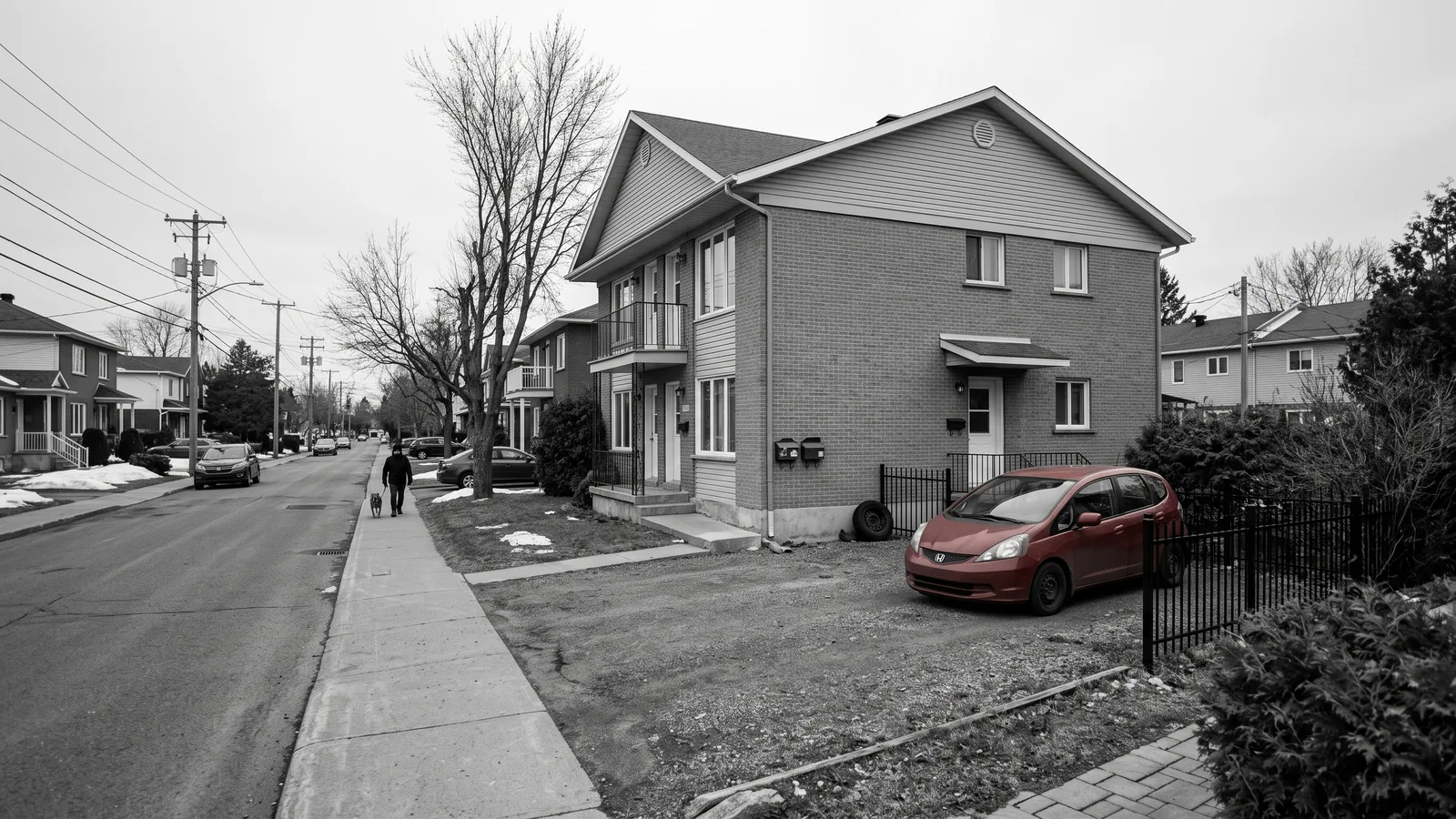
Some rulings make headlines because they feature a juicy detail: this time, the landlord who was fined is no ordinary defendant. He is a lawyer at the Canada Mortgage and Housing Corporation (CMHC) — in other words, a person who, by profession, operates in the world of housing. And yet, according to the Noovo Info report, he was ordered in Longueuil to pay more than $21,000 to his former tenant for having illegally evicted her. The court reportedly found an absence of good faith at every stage of the case. That is precisely what makes the affair instructive: if even an informed person falls, then the problem is not ignorance — it is the shortcut.
This article is not meant to judge an individual, but to dissect the legal mechanism that turns a repossession into a hefty bill. Because behind this case lies a lesson that applies to every landlord in Quebec: repossession is a real but narrow right, and circumventing it to get rid of a tenant costs infinitely more than the legal path. We will look at the facts as reported, why such an approach is illegal, what consequences it triggers, and above all what should have been done instead. This content is provided for information purposes only and does not constitute legal advice.
In this article
The facts of the case
Let's go over what the report states, without adding to it. In Longueuil, a landlord took back possession of a dwelling occupied by a tenant. This landlord is no stranger to the field: he works as a lawyer at CMHC, the federal agency at the heart of housing financing and policy in the country. The dispute ended up before the court, which ruled in the tenant's favour: the landlord was ordered to pay her more than $21,000 for an illegal repossession.
The central element of the ruling, as presented in the report, comes down to a single phrase: the court found an absence of good faith before, during and after the repossession. That wording is rich in meaning. It does not merely say that the landlord filled out a form incorrectly or missed a deadline. It says that, at every stage of the process — the preparation, the execution, then the aftermath — the real intention did not match the reason invoked. In other words, this was not a procedural slip-up: it was the plan itself that was flawed.
Since we do not have access to the full text of the decision, we remain cautious about details the report does not specify: we do not know the exact breakdown of the $21,000, nor the precise timeline of the actions complained of. We therefore stick to what is public and reported: an illegal repossession, an order to pay more than $21,000, and an absence of good faith found by the court at all three stages of the affair. That is more than enough to understand the principle.
Key takeaway
The crux of the case is not technical: it is good faith. The court reportedly found it was missing before, during and after the repossession. It was not a matter of form that cost the landlord $21,000 — it was the real intention behind the process.
Why it was illegal: the legal mechanics
To understand why a repossession can backfire so violently on a landlord, you have to grasp the logic of Quebec residential tenancy law. Three pillars come together here.
1. The right to remain in the dwelling
In Quebec, a tenant in good standing benefits from the right to remain in the dwelling, provided for in the Civil Code (notably at article 1936 C.c.Q.). In practical terms, as long as they pay their rent and meet their obligations, the tenant has the right to stay in their home, and their lease is renewed. This is one of the foundations of the whole structure: a landlord cannot simply decide that a tenant must leave because their rent has become too low or because the landlord wishes to regain control of their building. Repossession is the exception to this rule — and like any exception, it is strictly circumscribed.
2. Repossession must serve to occupy, not to evict
Repossession exists for a specific reason: to allow the landlord to house a person — themselves or an eligible relative defined by law (spouse, children, parents, certain other relatives of whom the landlord is the main support). It is not meant to reclaim a dwelling in order to re-rent it at a higher price, renovate it or sell it. When the stated reason for occupancy is merely a pretext, the repossession becomes a bad-faith repossession, and the law penalizes it. That is exactly the type of situation this case illustrates: the court found that the real intention did not match the stated reason. We detail this mechanism in our guide on the bad-faith repossession.
Article 1968 of the Civil Code is central here: it provides that a tenant evicted by a repossession or an eviction obtained in bad faith is entitled to damages for the harm suffered and, if the court sees fit, to punitive damages. This is the lever that turns a botched repossession into a five-figure judgment.
3. Harassment, the aggravating factor that weighs heavily
The third pillar is article 1902 C.c.Q., which prohibits a landlord — or any other person — from harassing a tenant in a way that restricts their peaceful enjoyment of the premises or leads them to leave their dwelling. Harassment can take many forms: repeated pressure, barely veiled threats, abusive renovation work, service cut-offs, intimidation. Without presuming what exactly happened in Longueuil, you can see why an absence of good faith "before, during and after" draws the court's attention: it describes continuous conduct, not a single isolated misstep. It is often this type of behaviour that tips a case — see our article on harassment of a tenant in Quebec.
Why being a lawyer changed nothing
The detail that fuelled the headlines — a CMHC lawyer being fined — deserves a closer look, because it carries a lesson. The law provides no immunity based on profession. Worse still, from the standpoint of good faith, an informed person is presumed to know the rules: they therefore have fewer excuses, not more. The court is not judging a degree or a title; it is judging actions. And actions inconsistent with the stated reason carry the same weight whether they come from a novice or a seasoned jurist. That is precisely what makes the case so telling: it shows that legal knowledge offers no protection when you choose the shortcut. It is not a question of knowledge, but of sincerity.
Key takeaway
A repossession becomes illegal when it serves to evict rather than to occupy. Three provisions structure the case: the right to remain in the dwelling (art. 1936 C.c.Q.), damages for bad-faith repossession (art. 1968 C.c.Q.) and the prohibition on harassment (art. 1902 C.c.Q.). No professional title shields anyone from these rules.

The consequences: damages, punitives and reputation
When a repossession is deemed illegal and in bad faith, the bill is made up of several items that, added together, explain how you reach an amount like the one in this case.
Damages for the actual harm
First come the compensatory damages, meant to restore the tenant, as far as possible, to the situation they should have been in. These typically include moving costs, the difference in rent when the tenant had to re-house themselves at a higher price, incidental costs tied to the forced move, and compensation for trouble, aggravation and inconvenience. Each item must be established, but their total climbs quickly: re-housing in a tight market, in Longueuil as elsewhere on the South Shore, is expensive, and the rent gap is often calculated over several months.
Punitive damages, the penalty that hurts
To this can be added punitive damages. Their logic is different: they do not repair a loss, they punish conduct and seek to deter it, both in the wrongdoer and in other landlords tempted by the same manoeuvre. It is precisely because the law wants to discourage false repossessions that article 1968 C.c.Q. makes them possible. A characterized bad-faith repossession — especially when accompanied by acts of pressure — is exactly the kind of case where a court may see fit to award them. We explain the scale of these penalties in our analysis of fines and penalties for renoviction and illegal eviction.
Reputation: the cost you won't see on the ruling
Finally, there is a cost that appears on no line of the ruling, but that can exceed $21,000: reputation. This case made the headlines precisely because it pits the image of a housing professional against conduct penalized by the courts. Once a name is publicly associated with an "illegal eviction," the trace remains. For a landlord, a professional, a person who must inspire trust, it is a damaged asset that a cheque cannot repair. Renovictions and abusive evictions regularly make the headlines in Quebec, and the media's appetite for these stories shows no sign of fading.
What should have been done: the legal path
Here is the part these rulings never tell: there was a perfectly legal way to reach a result, and it would have avoided the entire wreck. The question to ask, upfront, is always the same: is an eligible person actually going to live in this dwelling?
If occupancy was real: a genuine repossession
If an eligible relative had genuinely intended to move in, repossession would have been the right path — provided it was done correctly: a genuine reason, a compliant notice, respect for the timelines and, above all, a demonstrable good faith through consistent actions before, during and after. Proof of the sincerity of the plan is what protects a landlord acting in good faith. But the moment the occupancy is not real, the repossession becomes a minefield.
If the goal was to optimize or re-rent: the voluntary agreement
In the vast majority of cases where a landlord wants to "reclaim" a dwelling, they actually have no one to house there: what they want is to return to the market a dwelling frozen below its value. For that objective, the tool is not repossession — it is the voluntary agreement, commonly known as cash for keys (or cash for raise when you negotiate an accepted increase rather than a departure).
The principle is simple and perfectly legal: the landlord offers the tenant compensation in exchange for leaving on an agreed date. The tenant is free to accept or refuse; if they accept, both parties sign a clear lease-termination agreement. There is then no reason to justify, no burden of proof and no possible challenge, since the departure rests on consent, not on coercion. The law allows the parties to end a lease by mutual consent; that is exactly what cash for keys does. For the full mechanics, see our Cash for Keys page and our approach to rent optimization.
The contrast, in one sentence
The bad-faith repossession: you invent a reason, you push the tenant out, and you pay more than $21,000 when the truth comes out. The voluntary agreement: you make an offer, the tenant freely accepts, everyone signs — and there is nothing to challenge, because no one was deceived or forced.
The fundamental difference is not only legal, it is human. In one case, you impose a decision on someone under a false pretext; in the other, you present them with an offer they are free to weigh. It is this freedom of the tenant that puts the agreement beyond any accusation of bad faith. If you are still hesitating between the two approaches, our comparison of cash for keys versus renoviction details why the first is solid and the second, explosive.
Why go through professionals
At this point, you might think it is enough to "not lie" to avoid trouble. That is true in principle, but the Longueuil case is a reminder of a more subtle reality: the landlords who get fined are not all cynical wrongdoers. Many simply wanted to move fast, on their own, and crossed a line without gauging where it lay. A slightly forced reason, one push too many, an occupancy that never materializes: that is often how a vague intention turns, in the eyes of the court, into an absence of good faith.
This is where a firm specialized in voluntary agreements changes everything. Its role is not to "circumvent" the law — quite the opposite: it is to structure the process so that it stays, at every stage, on the right side. That means assessing the situation realistically, approaching the tenant properly, negotiating compensation that makes sense for both parties, and sealing it all in a written agreement that protects the landlord as much as the tenant. You replace improvisation with a proven process.
The Opti Loyer model: pay only for results
At Opti Loyer, we do exactly this work: helping landlords reclaim and optimize their dwellings through voluntary agreements, within the framework of the Tribunal administratif du logement. The initial analysis is free: together we look at the dormant value of your building and the feasibility of an agreement, with no commitment. And the model is pay only for results: you pay only if the agreement is reached and you obtain the result. The financial risk is on us, not on you.
It is also a way to protect what cannot be bought back. A landlord has only one name in life: gambling it on a shortcut that can end up in the headlines is a losing bet even when you "win" in the short term. The legal path is slower in appearance, but it is safer, more profitable once all the risks are counted, and it leaves everyone standing. If you want to understand why it is better to entrust this to specialists, read our article on why go through a professional to reclaim a dwelling.
The takeaways
This Longueuil case comes down to a few simple lessons, ones that too many landlords learn the hard way:
- Good faith is not a box to check, it is conduct. It is assessed before, during and after the repossession, through concrete actions — not through a reason written on a notice.
- Knowledge does not protect you from the shortcut. A CMHC lawyer was fined like anyone else: the penalty depends on what you do, not on what you know.
- A false repossession costs tens of thousands of dollars. Compensatory damages, punitive damages, not counting reputation: the bill almost always exceeds the value you hoped to recover.
- The tenant can act even after leaving. Leaving the dwelling does not close the door: if the promised occupancy does not materialize, the recourse remains open.
- The legal path exists and gives the same result. When the goal is to optimize or re-rent, the voluntary agreement — cash for keys — achieves the aim without any of the risks of a diverted repossession.
At bottom, these cases all tell the same story: a landlord who tried to force a result through the back door, when the front door was open. Repossession serves to occupy a dwelling; to reclaim and optimize it, the tool is the voluntary agreement. Choosing the right tool, from the start, is the difference between a profitable operation and a $21,000 headline.
This content is provided for information purposes only and does not constitute legal advice. The facts presented come from a news report; details that are undecided or unpublished are reported with caution. The rules and schedules of the Tribunal administratif du logement change over time — verify the current terms or consult a legal advisor before acting.